Portfolio Category: Commercial Revitalization

  • Public Life Evaluation

    Public Life Evaluation

    Street Level Advisors led a process for the John S. and James L. Knight foundation to evaluate a series of grants that the foundation has made to support the development of organizations focused on improving access to public space, and public life in American cities. The goal of this work was to connect and engage residents in their communities through more parks and public open spaces, bike and pedestrian lanes to enable people to connect, and programming that draws people together to share a common experience. This is an unusual focus for philanthropy and the Foundation wanted to know whether their investment was making a difference.

    Street Level interviewed nearly 50 neighborhood leaders and volunteers in communities where the funded work was conducted, listening to community stakeholders and capturing their sense of whether and how the work impacted the communities. In addition to documenting traditional measures of impact such as increases in the level of local spending and the number of permanent policy changes, we identified meaningful impacts related to community voice, identity, the development of local leadership and organizational capacity. We found that even temporary tactical urbanism type interventions (bike lanes, parklets, public events, etc.) could have a long-term impact. While the changes were not always lasting, we found that when the work was conducted in an inclusive and authentic way, local stakeholders reported lasting changes in community engagement. These creative public life projects seemed particularly likely to inspire new leaders and give them the confidence to undertake longer term efforts.

    Public Life Leadership Report cover

    Download the Report

  • Grocery Store Attraction Strategies

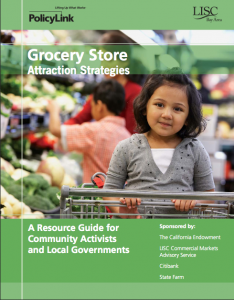
    Grocery Store Attraction Strategies

    Grocery Store Attraction Strategies

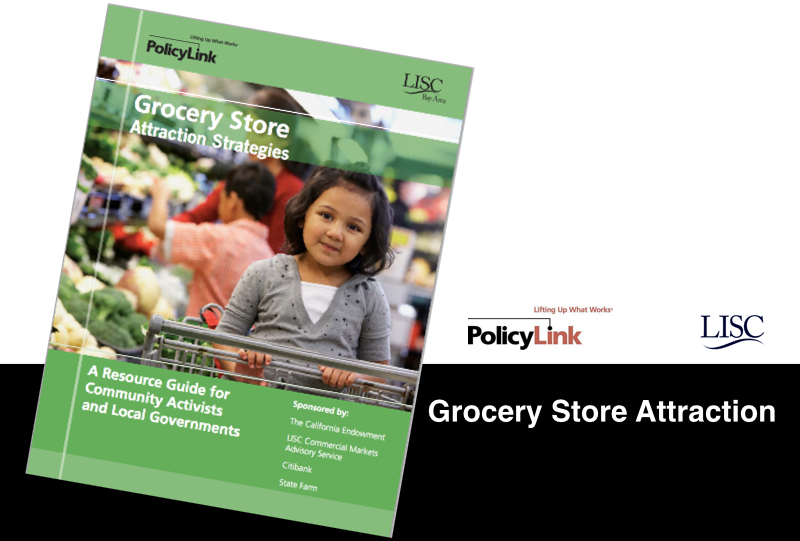
    A Resource Guide for Community Activists and Local Governments

    By Rick Jacobus and Maureen Hickey

    Download PDF File

    This report was commissioned by Bay Area LISC and PolicyLink with sponsorship from the California Endowment, LISC’s Commercial Markets Advisory Service, State Farm Insurance, and CitiBank. The report provides an overview of the process that community activists have used to attract new fresh food retailers into disinvested urban communities.

  • Economic Development and Health Toolkit

    Economic Development and Health Toolkit

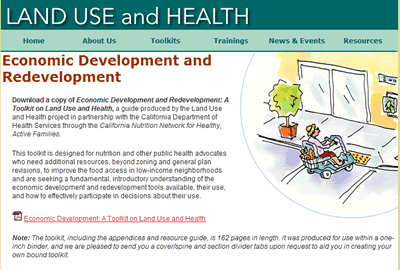
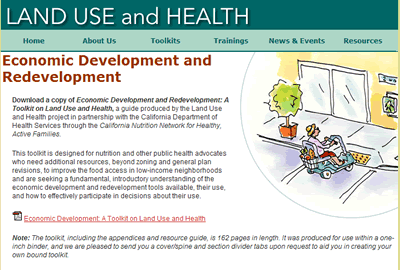
    Economic Development for Public Health Advocates

    PHI Web_med.png

    Now Online at ChangeLab Solutions

    Download PDF File

    This toolkit developed for the Public Health Institute’s Land Use and Health Program is designed to provide an overview of Economic Development and Redevelopment issues for health advocates seeking new food stores in low income communities.

    TABLE OF CONTENTS:
    Section I: Introduction to Economic Development, Redevelopment, and Health

    1. Introduction to this Toolkit
    2. The Connection Between Economic Development and Health
    3. Why Do So Many Communities Lack Access to Healthy Food?
    4. Developing a Strategy

    Section II: Economic Development

    5. What is Community Economic Development?
    6. Types of Community Economic Development Programs
    7. Economic Development Institutions
    8. Financing Sources

    Section III: Redevelopment

    9. Overview of Redevelopment Law
    10. Legal Requirements for Redevelopment
    11. Introduction to Tax Increment Financing
    12. Introduction to Eminent Domain
    13. Support for Economic Development Projects
    14. Final Points

    Section IV: Strategies for Participation

    15. Building Community Support
    16. Data Collection
    17. Model Redevelopment Resolution
    18. Communicating with Public Officials

    Section V: Appendices

    Appendix 1: Sample Market Research Consultant Request for Proposals
    Appendix 2: Redevelopment Agency Model Resolution
    Appendix 3: Resources

  • Brookings: Retail Trade as a Path to Neighborhood Revitalization

    Brookings: Retail Trade as a Path to Neighborhood Revitalization

    Buy the book on Amazon.com

    Download the chapter: Retail Trade as a Path to Neighborhood Revitalization by Karen Chapple and Rick Jacobus

    A condensed version of the chapter was also produced by UC Berkeley’s Center for Community Innovation.

    From the introduction:
    “Retail trade is a highly visible feature in a community, and is often a symbol of economic status. Terms like “upscale retail,” “strip mall,” or “big box store,” convey very different images of retail trade that are widely associated with economic prosperity, or the lack thereof. But, does retail trade really revitalize run down or neglected neighborhoods? And if so, what are the mechanisms at work, the successful strategies, and necessary conditions that lead to success? In “Retail Trade as a Route to Neighborhood Revitalization,” Karen Chapple and Rick Jacobus tackle these questions. They begin by defining the issues and expectations associated with retail development and neighborhood revitalization. The authors state that, from the perspective of residents, there are three types of neighborhood revitalization: more access to services and opportunities for low-income populations; changes from a low-income neighborhood to a mixed income neighborhood (due either to an influx of newcomers or increases in incomes for local residents); and gentrification that gradually replaces existing low-income residents with more affluent newcomers. Using a conceptual model, Chapple and Jacobus describe the relationship between retail development and neighborhood revitalization.

    Their review of the literature finds mixed evidence for the assumption that low-income neighborhoods are underserved, and limited formal evaluation of the effects of retail development, especially with respect to overall neighborhood improvement. The authors acknowledge the challenges to evaluating retail development programs, such as their small scale, the variety of actors involved, and limited neighborhood level capacity. In reviewing the evidence, Chapple and Jacobus examine three broad strategies to retail revitalization: public-led retail development, private-led retail development, and commercial corridor revitalization. Retail strategies variously target job creation, vacancy rates, private investment, public investment, tax revenues and property values, crime and safety, and community identity. In order to further explore the relationship between these retail development goals and neighborhood revitalization, Chapple and Jacobus provide a case study of the San Francisco Bay Area, analyzing the relationship between retail and neighborhood revitalization from 1990 to 2005 in a region with unusual increases in income inequality accompanied by significant revitalization. They find that the way the retail sector changes is closely related to how the neighborhood changes, with increases in middle income residents (rather than gentrification or other forms of change) most closely associated with retail revitalization.

    The paper concludes with the suggestion that any large-scale impacts of retail development on community economic health occur indirectly, such as through changes in internal and external perceptions of the neighborhood and, ultimately, changes in neighborhood residential composition. But, the authors note that existing studies of the effectiveness of neighborhood retail development strategies have not explored these broader impacts. Chapple and Jacobus also recommend further research to address how outcomes for the poor are tied to the specific character of neighborhood change. Such research might suggest specific retail development strategies that are most likely to benefit the poor and lead to stable mixed-income communities without contributing to displacement of the poor.”

  • Commercial Revitalization Planning Guide

    Commercial Revitalization Planning Guide

    Commercial District Revitalization Planning Guide
    Commercial District Revitalization Planning Guide

    By: Rick Jacobus and Maureen Hickey

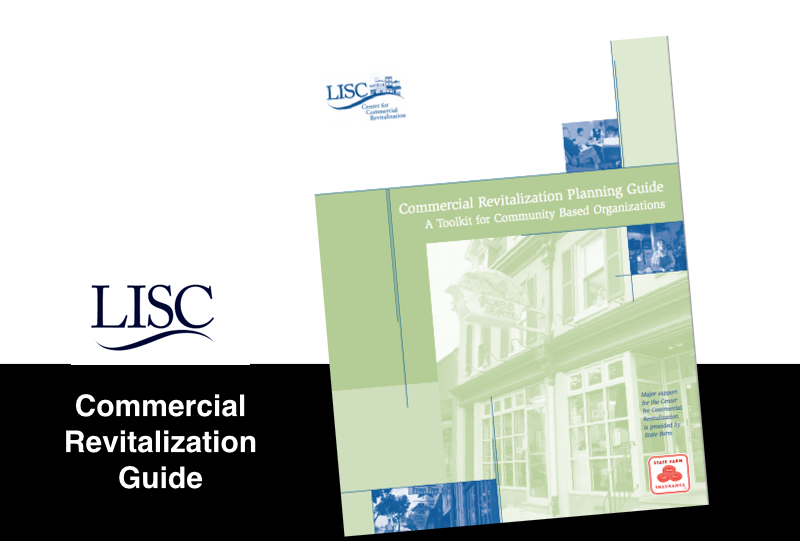
    This hands on guidebook is filled with detailed direction that will provide practitioners with a starting point for organizing comprehensive commercial district revitalization efforts. It takes the reader through each stage of revitalization from planning, research, and visioning to understanding the potential of the community, analyzing the business mix, marketing the assets, and implementing the work plan. The planning guide also provides a set of practical tools to assist in implementation.

    Table of Contents:
    Forward
    Urban Commercial Revitalization Programs
    Planning For Revitalization
    Identifying and Involving Stakeholders
    Developing a Community-Based Vision
    Compiling Building and Business Inventories
    Understanding Market Data
    Using Surveys and Interviews to Collect Local Market Data
    Assessing Crime and Community Safety
    Developing Business Attraction Goals
    Evaluate Streetscape Conditions
    Branding the District Identity
    Defining an Implementation Strategy
    Measuring Impact

    Appendix A: Hiring a Market Analysis Consultant
    Appendix B: Resources
    References
    Acknowledgements

    Download a PDF of the book

  • Joint Venture Guide

    Joint Venture Guide

    Joint Ventures Guide

    Joint Ventures with For-Profit Developers. A Guide for Community Development Corporations

    Written by Greg Maher, Rick Jacobus, Maegan Winning and Judy Turnock.

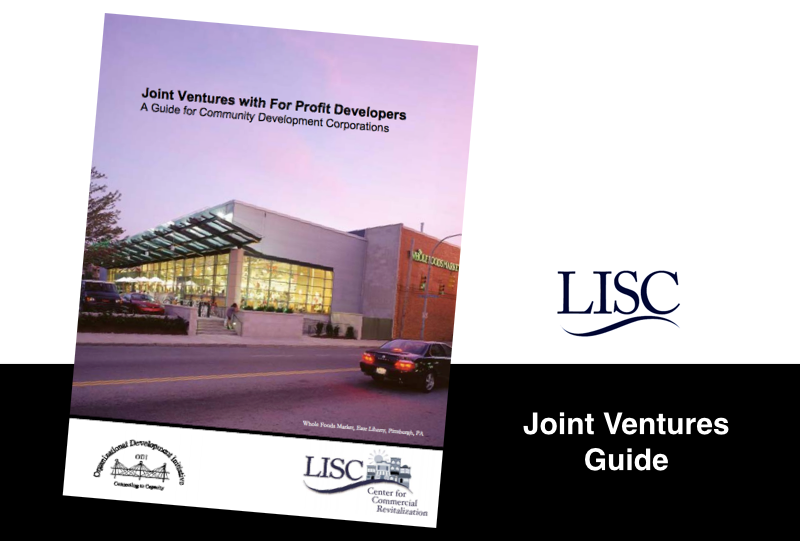
    This guide is designed to assist CDCs in becoming educated consumers as they think about, plan and become partners in joint ventures with for-profit developers.

    Joint ventures between a community development corporation (“CDC”) and a for-profit partner present tremendous opportunities for a CDC to build its skills and complete projects that are larger in scale and/or beyond its core competencies. However, there are a host of business issues raised by the prospect of a CDC co-owning or working closely with a for-profit on a project. Many issues need to be carefully negotiated for the CDC to protect its financial integrity and credibility. Based on Greg Maher’s 2005 memo, this guide is structured to assist CDCs in becoming educated consumers as they think about, plan and become partners in joint ventures with for-profit developers.

    Download PDF file

  • Commercial Development Training Program

    Commercial Development Training Program

    This series of day long and multi-day workshops developed for the Local Initiatives Support Corporation’s national Center for Commercial Revitalization was designed to help community development corporations and local governments understand the unique challenges associated with neighborhood retail development. Courses were delivered in communities around the country including: Philadelphia, Providence, Indianapolis, San Francisco, Toledo, Jacksonville, San Diego, Seattle, Miami and Cincinnati.

    Workshop topics include:

    Developing a Neighborhood Retail Strategy (1 day)
    Commercial District Revitalization 101 (2.5 days)
    Introduction to Commercial Real Estate Development (2 days)
    Developing a Retail Leasing Strategy (1 day)
    Joint Ventures with Private Developers (1 day)
    Financing Commercial Real Estate Projects (1 day)
    Negotiating Commercial Leases (1 day)
    Evaluating Commercial Tenants (1/2 day)
    Commercial Property and Asset Management (1 day)
    Overview of Commercial Real Estate Development (2.5 hours)
    Overview of Commercial District Revitalization (2.5 hours)

    Download flyer with detailed course descriptions


© Copyright 2012 – 2025 Street Level Advisors LLC  |  All Rights Reserved  |  Powered by WordPress

510.653.2995      Email Us