Author: Rick Jacobus

  • SF Chronicle: Coffee Shops Perk Up Streets

    Coffee shops perk up streets; SAN FRANCISCO; Cafes revitalize neighborhoods by providing safe gathering places, drawing other businesses

    Marisa Lagos, Chronicle Staff Writer
    The San Francisco Chronicle (California)
    October 25, 2008

    Neighborhoods like North Beach and Noe Valley are teeming with coffee shops, but head south and you’re likely to find people clamoring for a cafe.

    In recent years, these businesses have become a key part of community efforts to revitalize commercial strips, arguably the most visible and telling element of any neighborhood. Coffee shops offer a safe, warm gathering place for neighbors, bring foot traffic to areas that need it, and tend to reflect the flavor of a community.

    Sometimes they also lead to some unexpected benefits. In the Bayview, for example, Javalencia coffee shop owner Servio Gomez parlayed the success of his Third Street business – and its open mike nights – into an adjacent gallery, which focuses on local artists. Mama Art Cafe in the Excelsior district also showcases local artists and musicians, and often opens its door for community meetings. And at Joe Leland cafe in Visitacion Valley, people stop by just to chat with owner Russel Morine, whose business is filled with posters for community events.

    “There wasn’t a cafe on Mission Street in the Excelsior when I first became supervisor in 2001,” said Supervisor Gerardo Sandoval, adding that there are now three in the area. “It was one of the ideas that always came up when you sat down with a group and said, ‘What would you like to see happen to the street?’ I think that reflects a need that people have for community, and a space where they can come together and relax.”

    Draw for other businesses
    That’s exactly what Portola district neighbors have been asking for, said longtime resident Irene Crescio.

    “We’ve been trying to get a coffee shop on San Bruno Avenue for a good six, seven years,” she said. “Once we get a business like that in, it will draw other businesses.”

    Cafes can help draw other businesses to an area previously seen as unsafe or untenable, agreed Rick Jacobus, a retail revitalization consultant who has helped efforts in the Excelsior and Portola districts.

    “The presence or absence of different businesses telegraphs the success of a neighborhood,” he said. “A retail area is a neighborhood’s front door. It’s the face they present to the outside world. If you have a coffee shop, it sends a message about what kind of neighborhood you have. … It seems like it’s successful, safe and desirable.”

    Later hours
    They also make nighttime businesses, such as restaurants, more likely to move in, he said.

    “Cafes can have longer hours than other businesses,” he said. “In the Excelsior, people wanted the commercial district to feel like a safe place, but it felt closed up at night. You can’t just open up one restaurant and expect it to survive, but a coffee shop can stay open later and bring some eyes to the street.”

    That’s exactly what Javalencia and Art94124 have done since opening this year on Third Street in the Bayview, said India Basin resident Kristine Ennea. That commercial corridor lost a number of businesses during the drawn-out construction of the Third Street Light Rail.

    “It was sorely needed,” Ennea said of the cafe. “In the Bayview, probably more than any other neighborhood, there’s a perception of danger. If you have businesses clustered together, they start drawing in customers and people feel safe.”

    Gentrification fears
    The fear of gentrification is a real one, but neighbors say coffee shops, if done right, can actually bring together different groups that exist within neighborhoods. This is particularly the case when they are owned by community members, such as Morine, who grew up in the Bayview and has lived in Visitacion Valley for 12 years.

    “It wasn’t my goal to own a coffee shop,” said Morine, who recently completed his master’s degree in city planning from UC Berkeley. “But a cafe was the one thing the community wanted that we didn’t have that was doable. It’s a place for people to meet, sit and talk – and it’s there every day.”

    All income strata
    Many communities list other businesses, including grocery stores and bookstores, right up there with cafes when they are trying to revitalize commercial corridors. But coffee shops are often more likely to materialize because they are fairly simple retail businesses, Morine said.

    And, regardless of your ethnic or socioeconomic heritage, you can usually find something you like there, said Sandoval.

    “There are often questions about who will pay $3 for a cup of coffee, that it won’t be a lot of working-class people,” he said. “But surprisingly, that’s not the case – if you go into these cafes, you will find people from all economic stratums reading newspapers, using the Internet or talking to friends. People want a place to congregate and socialize.”

    Copyright 2008 San Francisco Chronicle All Rights Reserved

  • Shelterforce: Cities and CLTs

    Shelterforce: Cities and CLTs

    Download City Hall Steps In Written by Rick Jacobus and Michael Brown. Published By Shelterforce.

    This article from Shelterforce Magazine outlines the growing trend of municipal sponsorship of Community Land Trusts including profiles of new CLTs in Irvine, CA and Chicago.

    Shelterforce.jpg

  • Preservation of Affordable Homeownership

    Preservation of Affordable Homeownership

    Download Preservation of Affordable Homeownership: A Continuum of Strategies Written by Rick Jacobus and Jeff Lubel.
    Published by the Center for Housing Policy of the National Housing Conference.

    chp_se_transwealth_0407_sm.png

    In recognition of the significant benefits of homeownership for families and the communities in which they live, many cities, counties and states have adopted policies that seek to increase residents’ access to affordable homeownership opportunities. This paper examines the range of different policy options that communities have adopted to reduce the cost of homeownership, with a particular focus on the effectiveness of each option in preserving affordable homeownership opportunities over time.

    The focus of this review on the preservation of affordable homeownership grows out of the collective experience of numerous communities around the country with sharply rising home prices over the past five to ten years. As many communities have learned the hard way, homes that they helped make affordable through an initial downpayment grant or other assistance often have become unaffordable when sold to the next family. With the amount of subsidy needed to bring homeownership within reach of working families growing exponentially, communities have struggled with the question of how to ensure that the public’s investments in homeownership keep pace with the market. This review provides an overview of the range of mechanisms that local governments use to ensure that housing funds invested in affordable homeownership today are able to serve additional families into the future. In general, this is accomplished either through resale restrictions that preserve the affordability of specific assisted units or through deferred loans that allow the locality to capture a portion of home price appreciation at the time that assisted units are sold that can then be used to help subsequent buyers purchase homes of their choice.

  • San Francisco's Neighborhood Marketplace Initiative

    Mayor Newsom Announces Neighborhood Marketplace Initiative
    Unique program targets public, private resources
    to strengthen neighborhood business districts

    May 23, 2005

    SAN FRANCISCO – Speaking at a national conference on urban commercial district revitalization held in San Francisco today, Mayor Newsom announced a new program to bolster neighborhood business districts – the Neighborhood Marketplace Initiative. The initiative is a public-private partnership between the City of San Francisco, the nonprofit Local Initiatives Support Corporation (LISC), and private corporate and philanthropic donors. Coordinated by LISC and the City, the Neighborhood Marketplace Initiative (NMI) represents a major step forward in efforts to strengthen the city’s neighborhood business districts.

    The City and LISC are backing the Neighborhood Marketplace Initiative to improve job creation, investment and the physical landscapes in San Francisco’s neighborhoods. Piloted recently in the city’s Excelsior district with tremendous results and modeled on similar LISC-supported programs around the country, the Neighborhood Marketplace Initiative brings together business, resident, and other civic leaders in selected neighborhoods to develop and implement business district improvement strategies. Across the country similar programs have proven effective at reducing storefront vacancies, bringing in new businesses and jobs, and stimulating community involvement.

    “What makes this program unique, and why we are excited about it,” said Mayor Newsom, “is that we have city departments, LISC, and local funders coordinating work and dollars to assist our neighborhood business districts — and to assist the districts based upon what the residents and merchants say they need and want. It is a public-private partnership that is do-able and proven successful. It is exactly the kind of collaborative, targeted approach we need to help our neighborhoods and local businesses.”

    Under the Neighborhood Marketplace Initiative, the City and LISC jointly plan to invest approximately $500,000 annually to support neighborhoods selected for the program. Private funders play a pivotal role; approximately half of this investment is provided through donations to LISC from the State Farm Insurance Companies and the Evelyn & Walter Haas, Jr. Fund, among other funders. In addition, LISC is targeting an additional $25 million in flexible loan dollars ($10 million) and other financing ($15 million) for viable and desired development projects in neighborhoods selected to participate in the initiative.

    Five neighborhoods have been selected to receive initiative assistance as part of the program’s launch. The Excelsior and Visitacion Valley will receive assistance in implementing comprehensive commercial corridor plans while Third Street in the Bayview, San Bruno Avenue in the Portola neighborhood, and Ocean Avenue in the OMI (Ocean-Merced-Ingelside) neighborhood will all receive assistance in developing a comprehensive strategy and beginning implementation. The targeted neighborhoods will benefit from coordinated services from several city agencies. For example, some of the neighborhoods will receive priority for façade improvement grants through SF Shines, a program of the Mayor’s Office of Community Development as well as support from the Mayor’s office of Economic and Workforce Development in working with property owners, developers and retailers to fill vacant retail properties.

    Some of the targeted neighborhoods will also receive help in forming community benefit districts (CBD). Similar to a Business Improvement District, a CBD is formed when property owners in a proposed district voluntarily agree to a special assessment in addition to their regular property taxes, in order to finance capital improvements and services over and above those already provided by the City.

    “Because the City, LISC and other funders are working together to support these neighborhoods, we are not only using existing resources more effectively but we hope to engage more local corporate and philanthropic institutions in helping our neighborhoods”, said Stephanie Forbes, Director of LISC’s Bay Area program. “With this partnership, we now have the infrastructure for a new era of neighborhood change based upon residents and merchants working together on the ground, and the local funders and the City working together to support their visions. We can’t afford to work separately anymore.”

    The Mayor’s announcement was made at the opening session of a conference bringing together more than 400 neighborhood revitalization practitioners from around the country. Urban Forum 2005, the third such conference hosted by LISC’s Center for Commercial Revitalization, will include several workshops and presentations, with a special focus on successful efforts to help communities revitalize commercial corridors. The conference is being held today and tomorrow at the Bill Graham Civic Auditorium.

    LISC is a 25 year-old national nonprofit community development support organization that provides program models, policy analysis, training, technical assistance and financing to help community-based organizations working on behalf of our nation’s lower income families and neighborhoods. LISC works in 33 urban areas around the country and operates a rural program in 66 rural areas. LISC is the largest nonprofit community development financial institution in the country. Bay Area LISC has supported the region’s affordable housing and community development work since 1981.
    ####

  • Preserving Affordability in Inclusionary Housing

    Preserving Affordability in Inclusionary Housing Programs

    This half day workshop was offered as part of a training series organized by the Nonprofit Housing Association of Northern California for local housing activists working toward local inclusionary housing ordinances.

    DETAILED AGENDA:

    Goals:
    To give participants an opportunity to discuss and think about the social objectives of affordable homeownership programs and specifically about the tradeoffs between wealth creation and preservation of public subsidy.
    To familiarize participants with a wider range of alternative approaches that balance those interests differently
    To encourage critical thinking about existing programs and to model the kinds of questions that policy makers and program managers might ask to insure that their programs are appropriate to local circumstances.
    To expose participants to techniques for mathematically modeling long-term affordability and the consequences of program design choices.

    Handouts:
    Agenda
    One case study
    Example spreadsheet comparing approaches

    Materials:
    Powerpoint projector and laptop with speakers
    Flipchart and markers
    Sheets of 8.5×11 paper and tape
    Spare pens and blank paper

    Total Time: 3 hours

    1:00 Opening
    OK you just won your campaign and now developers in your community will be building affordable units into every new project. Low-income homebuyers will, at last have some homes within their price range. If you have done your advocacy work well, your program will produce brand new homes that look a lot like the market rate homes that they are built alongside but sell for hundreds of thousands of dollars less than the neighboring homes. What keeps the low-income families that move in from turning right around the next day and selling at market rate and pocketing all of that money? Would that be wrong?

    Audience response about preserving the stock, requiring people to live there for a fixed period, resale restrictions, shared equity, etc.

    Overview of workshop: this is a workshop about “WHY” we have affordable ownership programs. This is a workshop about thinking harder about the goals.

    Who I am:
    I noticed that local ownership programs varied very widely in how they balanced asset building and maintaining affordability. The only common factor was that the program managers were sure that what they were doing was “Fair”. How can we talk about “Fair” without knowing the goals of these programs? To most people what seemed fair was actually just the option that was most familiar. But there are a lot of options and while some may be truly unfair, it seems like there really is not a “most fair” approach. That is bad news because it means we have to do some hard work to balance different interests and clarify our values.

    1:15 Small Group Discussion: 15 Minutes
    Given the costs and subsidies required, and the developer’s goals…

    How should they handle the potential increases in the value of these homes?

    Should the homeowners be allowed to keep all of the increase in price?

    Should they have to return all of the increase to the developer or something in the middle?

    Large Group Discussion: 10 Minutes
    One or two present what they came up with.
    What are some other options?

    1:40 Video – Race the power of an Illusion

    Show a brief excerpt from this PBS video about race in America. The clip presents the story of how homeownership in postwar America functioned as a great wealth generator for white families while, housing market descrimination and federal lending policies meant most African-American families were unable to buy homes and those that did earned little equity.

    Discussion about how home equity can dramatically change people’s lives and the futures for their children.

    2:10 Flash Presentation: Understanding Subsidy Retention – 20 Minutes

    Animated presentation demonstrating the underlying economic differences between different approaches to preserving homeownership subsidy.

    2:30 Continuum of Subsidy Preservation Mechanisms – 15 Minutes
    Full group discussion focused on placing different approaches that participants are familiar with on a continuum between models that allow homeowners to earn unlimited equity and those that preserve public subsidy perfectly.

    Make a large post-it for each option
    – Grants
    – Forgivable Loans
    – Interest Free Deferred loans
    – Deferred Interest Loans
    – Shared Equity Loans
    – Resale Price Restrictions
    — Appraisal Based
    — Indexed
    — Mortgage based

    2:45 Other Factors to consider in program design:
    Every program needs:
    1)A pricing formula, which defines the maximum price at which the housing may be rented or resold; a cap intended to maintain rents and resale prices at an affordable level for some targeted class of low-income or moderate-income persons while providing a modest build up of equity if homeownership is involved;
    2)a legal mechanism by which the pricing formula is contractually imposed on the housing’s current (and future) owners; and
    3)An administrative structure for monitoring and enforcing any restrictions on price (and use) imposed on the housing.

    Some other issues
    Owner Occupancy/Subletting
    Longevity/stability: Do you want people to stay?
    Improvements: Do you want people fixing their homes up?
    Administration – Outsourcing
    Monitoring
    Dealing with law suits
    Marketing resales

    3:00 Detailed Comparison of Two Mechanisms

    Case #1: Shared Equity Loan Agreement
    Small Group Activity: – 15 Minutes
    Handout two legal documents and ask groups to summarize the relevant terms and identify some potential strengths and weaknesses of each approach to preservation of subsidy. Under what circumstances would this approach make sense?

    Full group discussion: – 15 Minutes
    Did all the groups come to the same conclusions?
    Which of these two approaches works better?
    Which preserves affordability best?
    Which generates the most wealth creation?
    Which is easiest to administer?
    Do these approaches work as well under different assumptions about inflation and interest rates?

    3:30 Modeling Long-Term Affordability Under Changing Market Conditions
    (30 Minutes)

    Project at an Excel spreadsheet which compares the several alternative resale price restriction formulas under several different interest rate and price inflation scenarios.

    Download the spreadsheet

    4:00 Adjourn

  • Creating Permanently Affordable Homeownership with CLTs

    Creating Permanently Affordable Homeownership with CLTs

    [fusion_builder_container hundred_percent=”yes” overflow=”visible”][fusion_builder_row][fusion_builder_column type=”1_1″ background_position=”left top” background_color=”” border_size=”” border_color=”” border_style=”solid” spacing=”yes” background_image=”” background_repeat=”no-repeat” padding=”” margin_top=”0px” margin_bottom=”0px” class=”” id=”” animation_type=”” animation_speed=”0.3″ animation_direction=”left” hide_on_mobile=”no” center_content=”no” min_height=”none”]

    Subsidy Retention
    Subsidy Retention

    By Rick Jacobus and Amy Cohen

    in California Affordable Housing Deskbook, Solano Press.

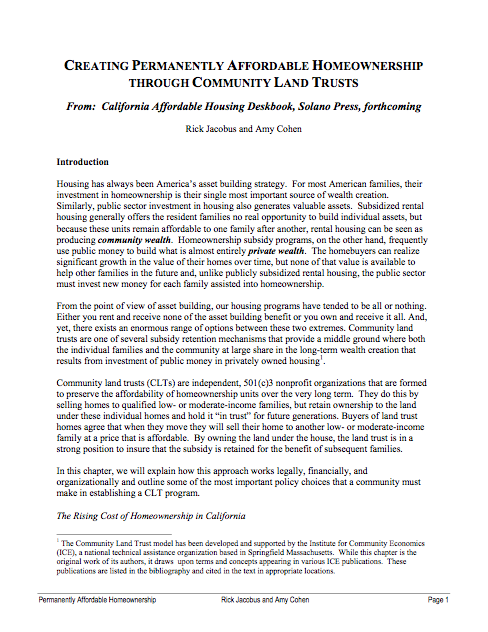
    Written for local elected officials and housing program administrators, this chapter explains how Community Land Trusts operate and places them within a continuum of other policy alternatives.

    Download the PDF file[/fusion_builder_column][/fusion_builder_row][/fusion_builder_container]

  • Commercial Stabilization ToolKit

    Commercial Stabilization ToolKit

    PLBanner.png

    Produced for PolicyLink’s Equitable Development ToolKit

    Commercial districts in low- and moderate-income urban neighborhoods can be sources of blight and crime or they can contribute to the economic and social health of the community. However, efforts to improve commercial districts often struggle with how to strengthen a district without contributing to gentrification and displacement. As part of their Equitable Development Toolkit PolicyLink asked me to write this paper describing ways that community groups are managing this tension and highlighting some initial lessons learned from these efforts. The paper provides real world examples that support the idea that stabilizing and improving a neighborhood serving commercial district can not only be achieved without fueling gentrification it may be a necessary step in preventing gentrification.

    Download PDF File


  • Beyond Lender Bias: The Struggle for Capital in a Networked Economy

    Beyond Lender Bias: The Struggle for Capital in a Networked Economy

    [fusion_builder_container hundred_percent=”yes” overflow=”visible”][fusion_builder_row][fusion_builder_column type=”1_1″ background_position=”left top” background_color=”” border_size=”” border_color=”” border_style=”solid” spacing=”yes” background_image=”” background_repeat=”no-repeat” padding=”” margin_top=”0px” margin_bottom=”0px” class=”” id=”” animation_type=”” animation_speed=”0.3″ animation_direction=”left” hide_on_mobile=”no” center_content=”no” min_height=”none”]

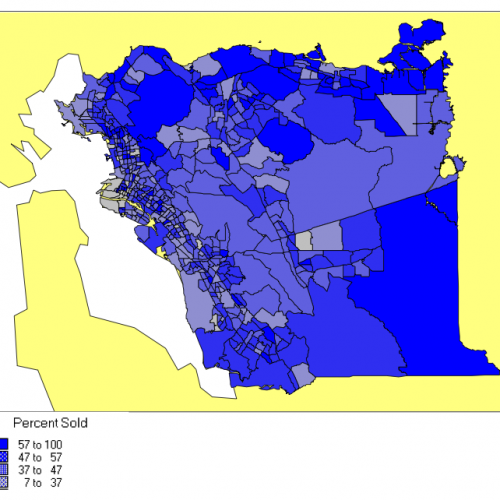
    Rate at which Oakland There are real neighborhood differences in the rate at which home mortgages were resold on the secondary market.
    There are real neighborhood differences in the rate at which home mortgages were resold on the secondary market.

    There is no doubt that information technology has brought about huge changes in world financial markets. Markets which used to be largely isolated are now inextricably interconnected by a real time network of transactions in which, generally, capital flows instantly to the highest bidder regardless of the location of that bidder on the globe. We might expect this trend, which Richard O’Brian calls this “the end of geography,” to be good news for low-income communities. One could conclude that the development of an integrated and standardized financial network, by reducing the role of potentially biased individual lenders, could reduce racial and income discrimination and move the economy toward a situation where capital is allocated based entirely on the real value which various sectors contribute. And yet low-income urban communities in America and elsewhere appear to be experiencing increasing capital shortages.

    This paper identifies an emerging structural logic of the financial system under which investment decisions are made by a network that relies on previous transactions as the main source for information about credit quality. The home mortgage market in the United States is examined as a specific case of this more general global financial market transformation. Data relating to the secondary market for single family home mortgages in the Oakland, CA metropolitan area is employed to provide empirical support for the argument that the emerging financial network itself has distinct geographic preferences which place low-income and minority neighborhoods at a systematic disadvantage in the competition for capital.

    Download the PDF[/fusion_builder_column][/fusion_builder_row][/fusion_builder_container]


© Copyright 2012 – 2025 Street Level Advisors LLC  |  All Rights Reserved  |  Powered by WordPress

510.653.2995      Email Us