Author: Rick Jacobus

  • ChatGPT can evaluate complex public comments

    [fusion_builder_container hundred_percent=”no” hundred_percent_height=”no” hundred_percent_height_scroll=”no” hundred_percent_height_center_content=”yes” equal_height_columns=”no” menu_anchor=”” hide_on_mobile=”small-visibility,medium-visibility,large-visibility” status=”published” publish_date=”” class=”” id=”” background_color=”” background_image=”” background_position=”center center” background_repeat=”no-repeat” fade=”no” background_parallax=”none” enable_mobile=”no” parallax_speed=”0.3″ video_mp4=”” video_webm=”” video_ogv=”” video_url=”” video_aspect_ratio=”16:9″ video_loop=”yes” video_mute=”yes” video_preview_image=”” border_size=”” border_color=”” border_style=”solid” margin_top=”” margin_bottom=”” padding_top=”” padding_right=”” padding_bottom=”” padding_left=””][fusion_builder_row][fusion_builder_column type=”2_3″ layout=”2_3″ spacing=”” center_content=”no” link=”” target=”_self” min_height=”” hide_on_mobile=”small-visibility,medium-visibility,large-visibility” class=”” id=”” background_color=”” background_image=”” background_image_id=”” background_position=”left top” background_repeat=”no-repeat” hover_type=”none” border_size=”0″ border_color=”” border_style=”solid” border_position=”all” border_radius=”” box_shadow=”no” dimension_box_shadow=”” box_shadow_blur=”0″ box_shadow_spread=”0″ box_shadow_color=”” box_shadow_style=”” padding_top=”” padding_right=”” padding_bottom=”” padding_left=”” margin_top=”” margin_bottom=”” animation_type=”” animation_direction=”left” animation_speed=”0.3″ animation_offset=”” last=”no”][fusion_text columns=”” column_min_width=”” column_spacing=”” rule_style=”default” rule_size=”” rule_color=”” hide_on_mobile=”small-visibility,medium-visibility,large-visibility” class=”” id=””]

    Like everyone else, I have been captivated by the capability of the ChatGPT AI.  I have been trying to think through the potential uses in my work.  For controversial development projects or public policies we often have public hearings at which hundreds of people provide comments. Even with a transcript of the comments, it is often frustratingly difficult to DO ANYTHING with the comments because it is just overwhelmingly too much text.

    Sometimes some poor intern is given the task of going through all the comments and creating a summary.  I wanted to see if OpenAI’s GPT3.5 AI could do this job.

    To test the idea, I used public comments collected by BART during a public meeting to select a development team for a housing project at the site of the North Berkeley BART station.  BART had two potential development teams present to the public and then they asked members of the public to complete an online survey. Each person provided 1-5 ratings on several factors and also had a chance to provide richer feedback in an open ended text box. The scoring results were immediately useful but the detailed text feedback is much harder to make use of.

    The combination of numeric scores and text created an opportunity to test the AI’s ability to evaluate sentiment from open ended text (which might not be so conveniently accompanied by scores in other contexts).

    Following a methodology and very simple code published on twitter by Shubhro Saha, I set up a google sheet with BART’s published data linked to the OpenAI API (text-davinci-003).  The spreadsheet has a column with the text comments from users – one per row. I created a new column that used Saha’s code to feed the user’s comments to GPT and return a 25 word summary of each comment.  The result was stunning.

    [/fusion_text][/fusion_builder_column][fusion_builder_column type=”1_3″ layout=”1_3″ spacing=”” center_content=”no” link=”” target=”_self” min_height=”” hide_on_mobile=”small-visibility,medium-visibility,large-visibility” class=”” id=”” background_color=”” background_image=”” background_image_id=”” background_position=”left top” background_repeat=”no-repeat” hover_type=”none” border_size=”0″ border_color=”” border_style=”solid” border_position=”all” box_shadow=”no” box_shadow_blur=”0″ box_shadow_spread=”0″ box_shadow_color=”” box_shadow_style=”” animation_type=”” animation_direction=”left” animation_speed=”0.3″ animation_offset=”” last=”no”][fusion_imageframe image_id=”181573|full” max_width=”” style_type=”” blur=”” stylecolor=”” hover_type=”none” bordersize=”” bordercolor=”” borderradius=”” align=”none” lightbox=”no” gallery_id=”” lightbox_image=”” lightbox_image_id=”” alt=”” link=”” linktarget=”_self” hide_on_mobile=”small-visibility,medium-visibility,large-visibility” class=”” id=”” animation_type=”” animation_direction=”left” animation_speed=”0.3″ animation_offset=””]https://streetleveladvisors.com/wp-content/uploads/sites/4/2022/12/Screen-Shot-2022-12-17-at-4.10.09-PM.png[/fusion_imageframe][fusion_text columns=”” column_min_width=”” column_spacing=”” rule_style=”default” rule_size=”” rule_color=”” hide_on_mobile=”small-visibility,medium-visibility,large-visibility” class=”” id=””]

    Open AI’s GPT 3.5 AI illustrates the potential for AI to review and analyze open ended public comments including the ability to make potentially complex judgements about the content of those comments.

    [/fusion_text][/fusion_builder_column][/fusion_builder_row][/fusion_builder_container][fusion_builder_container hundred_percent=”no” hundred_percent_height=”no” hundred_percent_height_scroll=”no” hundred_percent_height_center_content=”yes” equal_height_columns=”no” menu_anchor=”” hide_on_mobile=”small-visibility,medium-visibility,large-visibility” status=”published” publish_date=”” class=”” id=”” background_color=”” background_image=”” background_position=”center center” background_repeat=”no-repeat” fade=”no” background_parallax=”none” enable_mobile=”no” parallax_speed=”0.3″ video_mp4=”” video_webm=”” video_ogv=”” video_url=”” video_aspect_ratio=”16:9″ video_loop=”yes” video_mute=”yes” video_preview_image=”” border_size=”” border_color=”” border_style=”solid” margin_top=”” margin_bottom=”” padding_top=”” padding_right=”” padding_bottom=”” padding_left=””][fusion_builder_row][fusion_builder_column type=”1_1″ layout=”1_1″ spacing=”” center_content=”no” link=”” target=”_self” min_height=”” hide_on_mobile=”small-visibility,medium-visibility,large-visibility” class=”” id=”” background_color=”” background_image=”” background_image_id=”” background_position=”left top” background_repeat=”no-repeat” hover_type=”none” border_size=”0″ border_color=”” border_style=”solid” border_position=”all” box_shadow=”no” box_shadow_blur=”0″ box_shadow_spread=”0″ box_shadow_color=”” box_shadow_style=”” animation_type=”” animation_direction=”left” animation_speed=”0.3″ animation_offset=”” last=”no”][fusion_imageframe image_id=”181567|full” max_width=”” style_type=”” blur=”” stylecolor=”” hover_type=”none” bordersize=”” bordercolor=”” borderradius=”” align=”none” lightbox=”no” gallery_id=”” lightbox_image=”” lightbox_image_id=”” alt=”” link=”” linktarget=”_self” hide_on_mobile=”small-visibility,medium-visibility,large-visibility” class=”” id=”” animation_type=”” animation_direction=”left” animation_speed=”0.3″ animation_offset=””]https://streetleveladvisors.com/wp-content/uploads/sites/4/2022/12/Picture2.png[/fusion_imageframe][fusion_text columns=”” column_min_width=”” column_spacing=”” rule_style=”default” rule_size=”” rule_color=”” hide_on_mobile=”small-visibility,medium-visibility,large-visibility” class=”” id=””]

    With some exceptions, the results were both more accurate and more readable than what is generally produced when humans are assigned this same task. And even when humans are able to do it accurately, this is actually very hard and time-consuming work. OpenAI performed the task instantly and at a cost well under $1.  Now, the pricing could change, but I don’t see a reason to think it would.

    The glaring exception was that in cases where the person provided no text comment (ie. Where the comment field was blank), the AI simply made up a summary of an imaginary comment. These summaries were very consistent with the kinds of things that people typically say in meetings like this but were NOT based on actual things that real people said in this particular forum.  While this seems like weird behavior, it is a well understood aspect of large language AI models like ChatGPT.  What the AI is doing is not really answering questions, it is predicting the most likely text that would complete a query. When we feed it a public comment, the most likely summary is one that fairly accurately matches that comment.  But when we feed it nothing, the most likely summary seems to be based on typical comments instead of any one actual comment. In the absence of real data, the model bullshits! And it does so very convincingly.  Someone reading the summaries and ignoring the full comments would never guess that these blank line summaries were false.

    It is easy enough to fix this specific problem by not asking for summaries when the comment field is blank, but it points to a much more pervasive reliability challenge. This is the reason that Open AI says that the AI should not yet be used for tasks that really matter. There is simply no way to know when it is bullshitting us.

    Nonetheless, I think that the summaries it produces from the actual comments were valuable enough to be very helpful right now. Compared to having no summary of this important feedback, having a summary with some degree of unsupported embellishment is much better than nothing.

    But the tool appears to be capable of much more than simple summarization.  In addition to summarizing, I asked OpenAI to consider whether each comment was more positive, negative or neutral and again it did an impressive job.  The model accurately picks up on subtle clues about whether a comment is supportive or critical. Similarly, it was able to provide separate summaries of positive vs negative comments. If a commenter mentioned both pros and cons of the development team’s proposal, the model was able to pull them apart.  This enables us to craft a master summary that highlights the range of positive comments and also the range of concerns that the community raised in their comments without manually reading each one.  It also seems like we could easily create an index of which comments referenced which aspects of the team or their proposal without relying on keywords.  Ie. we could easily ask whether a comment referenced building height or density and expect it to flag comments that mention how many stories a building was even if they didn’t use the specific words “height” or “density.”

    [/fusion_text][fusion_imageframe image_id=”181568|full” max_width=”” style_type=”” blur=”” stylecolor=”” hover_type=”none” bordersize=”” bordercolor=”” borderradius=”” align=”none” lightbox=”no” gallery_id=”” lightbox_image=”” lightbox_image_id=”” alt=”” link=”” linktarget=”_self” hide_on_mobile=”small-visibility,medium-visibility,large-visibility” class=”” id=”” animation_type=”” animation_direction=”left” animation_speed=”0.3″ animation_offset=””]https://streetleveladvisors.com/wp-content/uploads/sites/4/2022/12/Picture3.png[/fusion_imageframe][fusion_text columns=”” column_min_width=”” column_spacing=”” rule_style=”default” rule_size=”” rule_color=”” hide_on_mobile=”small-visibility,medium-visibility,large-visibility” class=”” id=””]

    In some ways the most impressive thing about this experiment was that I was able to query the AI in plain English. The script I downloaded simply takes any input text and feeds it to OpenAI and returns the text that the GPT3.5 model provides.  I didn’t have to learn any coding or script or read any API manual. I didn’t have to carefully construct queries in some obscure format. I just fed it the user’s comment and added “is this a positive comment?” and it returned an answer that was nearly always the right answer.

    To push the system, I went a couple steps further until I finally felt like I was exceeding its capacity.  For example, ChatGPT knows what a NIMBY is.  It was able to identify comments that stressed concern for parking or neighborhood character as “NIMBY” comments whether the commenter was supporting or criticizing the proposed development team. I provided no definition of “NIMBY” but asked why it thought comments were NIMBY and its answers were often convincing.  Similarly, it knows what a YIMBY is. It accurately categorized comments that were enthusiastic about more building, more density, less parking as YIMBY comments without any training from me.

    As a side note, I recognize that the term “NIMBY” is used pejoratively to delegitimize concerns about neighborhood character.  I would prefer to use a different term for this analysis but in this context there really is a strong split in the community between neighbors who are concerned about negative impacts on their own quality of life and others who are supportive of the potential of more intensive development to address the broader housing shortage in spite of possible impacts on immediate neighbors.  My personal opinion is that certain aspects of neighborhood character are worthy of preservation and standing up for your neighborhood can be important even though I recognize that so often ‘neighborhood character’ is simply being used as a code for a desire to exclude on the basis of race and class. The AI model lumps racist NIMBYism together with any more enlightened neighborhood concerns – because this is how the term is most widely used online. It seems like it would be easy to provide the model with more nuanced, less loaded terms but I just didn’t take the time to do that for this experiment.

    But whatever terminology we use, this is the defining conflict around the North Berkeley BART Station and so many other development projects.  If the AI can sort the comments into two buckets, one for those who express concerns about impacts on current neighbors and one for those who express support for more building generally, it would be informative to then see how each development team scored within each of these two groupings. BART provided a tally of the overall average scoring for both teams and the development team that was ultimately selected was the top scorer (though, obviously many factors beyond these public surveys led to that choice).  But did the YIMBYs and NIMBY’s score the two teams differently?

    [/fusion_text][fusion_imageframe image_id=”181573|full” max_width=”” style_type=”” blur=”” stylecolor=”” hover_type=”none” bordersize=”” bordercolor=”” borderradius=”” align=”none” lightbox=”no” gallery_id=”” lightbox_image=”” lightbox_image_id=”” alt=”” link=”” linktarget=”_self” hide_on_mobile=”small-visibility,medium-visibility,large-visibility” class=”” id=”” animation_type=”” animation_direction=”left” animation_speed=”0.3″ animation_offset=””]https://streetleveladvisors.com/wp-content/uploads/sites/4/2022/12/Screen-Shot-2022-12-17-at-4.10.09-PM.png[/fusion_imageframe][fusion_text columns=”” column_min_width=”” column_spacing=”” rule_style=”default” rule_size=”” rule_color=”” hide_on_mobile=”small-visibility,medium-visibility,large-visibility” class=”” id=””]

    Unfortunately, this is where I think we exceed the capacity of the current tool.  For comments with a clear YIMBY or NIMBY character, the AI was able to reliably identify that leaning and provide an accurate account for why each comment was either NIMBY or YIMBY.  But the problem came when dealing with comments with no clear leaning (the majority of comments). Here, as with the blank comments, in the absence of clear evidence, the AI model simply makes up answers.  It characterizes a positive comment about how the team included a homeless shelter operator as a NIMBY comment because the commenter is desiring to improve their neighborhood by housing the homeless!  Submit the same comment again and the result flips and now it is considered YIMBY because it is supportive of the team which is proposing a development project and therefore the commenter must be pro-building. Because these large language AI models are based on probabilities, when the answer is not clear, the model rolls the dice to pick an answer.  Ask again and it rolls again.

    The result is that, while I think the YIMBY/NIMBY analysis is tantalizing and shows the potential of the technology to really open up very meaningful analysis of open ended public comments, I don’t think it can be relied upon for this today. Perhaps, more training (of either the AI or me the user) would enable a more reliable result.  There may be ways to ask the model to evaluate these comments that would help it do a better job ignoring the comments that are unclear and focus only on those with clear agendas.

    In spite of the limitations, I think that the technology shows incredible promise for unlocking the very real value that is often lost in detailed public comments. Everyone seems to agree that public engagement and input is important but, in part because it is so hard to digest these comments, public agencies often find themselves undertaking complex, expensive and time consuming engagement efforts that result in enormous files of essentially unreadable data.  AI that can understand what people are trying to say can consolidate that information and transform it into a format that can more effectively influence public decision making.

    Even with the current technology, it seems entirely practical to build a surveybot that would ask people for open ended comments on a development project and then summarized those comments and showed them to the user giving them a chance to correct any misunderstanding before submitting them.  People have grown accustomed to the idea that their comments on surveys are mostly ignored but a survey that could highlight the most common themes among people’s open comments would be very valuable to policymakers.

    [/fusion_text][/fusion_builder_column][/fusion_builder_row][/fusion_builder_container]
  • Comparing Shared Equity Resale Formulas

    [fusion_builder_container hundred_percent=”no” hundred_percent_height=”no” hundred_percent_height_scroll=”no” hundred_percent_height_center_content=”yes” equal_height_columns=”no” menu_anchor=”” hide_on_mobile=”small-visibility,medium-visibility,large-visibility” status=”published” publish_date=”” class=”” id=”” background_color=”” background_image=”” background_position=”center center” background_repeat=”no-repeat” fade=”no” background_parallax=”none” enable_mobile=”no” parallax_speed=”0.3″ video_mp4=”” video_webm=”” video_ogv=”” video_url=”” video_aspect_ratio=”16:9″ video_loop=”yes” video_mute=”yes” video_preview_image=”” border_size=”” border_color=”” border_style=”solid” margin_top=”” margin_bottom=”” padding_top=”” padding_right=”” padding_bottom=”” padding_left=””][fusion_builder_row][fusion_builder_column type=”2_3″ layout=”2_3″ spacing=”” center_content=”no” link=”” target=”_self” min_height=”” hide_on_mobile=”small-visibility,medium-visibility,large-visibility” class=”” id=”” background_color=”” background_image=”” background_image_id=”” background_position=”left top” background_repeat=”no-repeat” hover_type=”none” border_size=”0″ border_color=”” border_style=”solid” border_position=”all” border_radius=”” box_shadow=”no” dimension_box_shadow=”” box_shadow_blur=”0″ box_shadow_spread=”0″ box_shadow_color=”” box_shadow_style=”” padding_top=”” padding_right=”” padding_bottom=”” padding_left=”” margin_top=”” margin_bottom=”” animation_type=”” animation_direction=”left” animation_speed=”0.3″ animation_offset=”” last=”no”][fusion_text columns=”” column_min_width=”” column_spacing=”” rule_style=”default” rule_size=”” rule_color=”” hide_on_mobile=”small-visibility,medium-visibility,large-visibility” class=”” id=””]

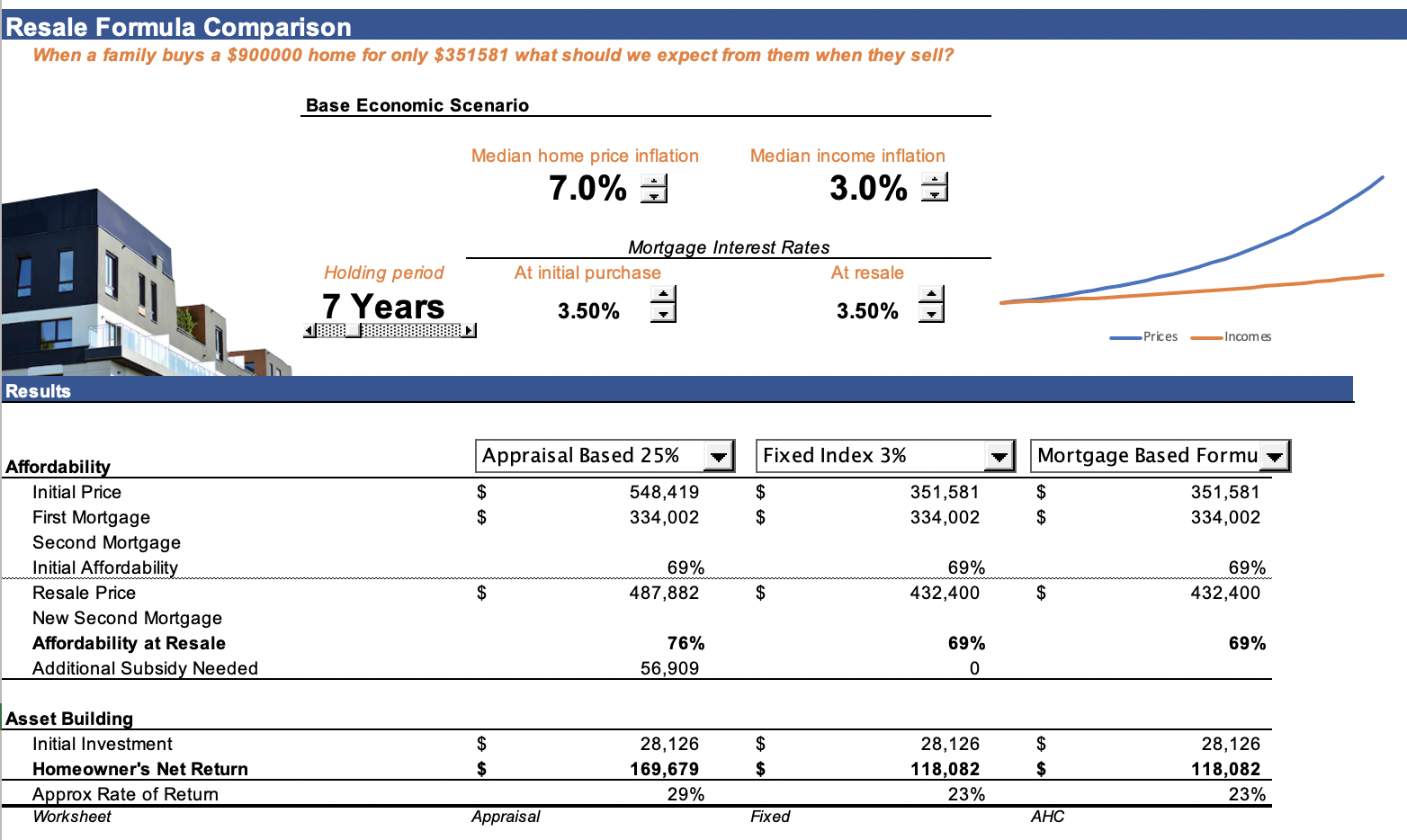
    This general purpose educational tool was designed to help community leaders understand the relative performance of different shared equity resale formulas. So much of what sets one model apart from the other is dependent on the assumptions you make about interest rates, home price inflation and income growth. This tool allows a side-by-side comparison between several models, and allows you to change these input assumptions and immediately see changes in the relative performance of each of the models in terms of both ongoing affordability and equity building for homeowners.

    The tool is intended to help policy makers and community members to evaluate questions like:
    · When housing costs are rising rapidly, which approach preserves affordability best?
    · Which approach provides the greatest asset building opportunity in the face of rising interest rates?
    · If incomes grow more slowly than we expect, which approaches will be most impacted?

    You can make the analysis more relevant to your local conditions by customizing a number of background assumptions like cost of building a new affordable unit, the level of subsidy available, and the monthly housing costs that homeowners will face.

    The latest version of the tool is an interactive Excel file.  The tool includes 8 commonly used shared equity resale formulas and 5 custom models which can be modified to match existing or proposed local program designs. The excel version also allows the user to save up to 5 alternative economic scenarios to understand how the formulas perform under different potential futures (ie. rising interest rates, falling home prices, etc.)  The tool is locked so that it is safe for inexperienced users to play with alternatives but not password protected to allow power users to make small or large modifications. The excel file is released under an open source license which allows for free sharing and modification.

    Download the excel file here.

    [/fusion_text][/fusion_builder_column][fusion_builder_column type=”1_3″ layout=”1_3″ spacing=”” center_content=”no” link=”” target=”_self” min_height=”” hide_on_mobile=”small-visibility,medium-visibility,large-visibility” class=”” id=”” background_color=”” background_image=”” background_image_id=”” background_position=”left top” background_repeat=”no-repeat” hover_type=”none” border_size=”0″ border_color=”” border_style=”solid” border_position=”all” border_radius=”” box_shadow=”no” dimension_box_shadow=”” box_shadow_blur=”0″ box_shadow_spread=”0″ box_shadow_color=”” box_shadow_style=”” padding_top=”” padding_right=”” padding_bottom=”” padding_left=”” margin_top=”” margin_bottom=”” animation_type=”” animation_direction=”left” animation_speed=”0.3″ animation_offset=”” last=”no”][fusion_text columns=”” column_min_width=”” column_spacing=”” rule_style=”default” rule_size=”” rule_color=”” hide_on_mobile=”small-visibility,medium-visibility,large-visibility” class=”” id=””]

    The Resale Comparison Calculator allows side by side comparison of the most common types of shared equity resale formulas, showing how well they preserve affordability for future buyers as well as their performance in building wealth for homeowners.

    [/fusion_text][/fusion_builder_column][/fusion_builder_row][/fusion_builder_container]
  • 2018 Recap

    2018 Recap

    [fusion_builder_container hundred_percent=”no” equal_height_columns=”no” menu_anchor=”” hide_on_mobile=”small-visibility,medium-visibility,large-visibility” class=”” id=”” background_color=”” background_image=”” background_position=”center center” background_repeat=”no-repeat” fade=”no” background_parallax=”none” enable_mobile=”no” parallax_speed=”0.3″ video_mp4=”” video_webm=”” video_ogv=”” video_url=”” video_aspect_ratio=”16:9″ video_loop=”yes” video_mute=”yes” video_preview_image=”” border_size=”” border_color=”” border_style=”solid” margin_top=”” margin_bottom=”” padding_top=”” padding_right=”” padding_bottom=”” padding_left=””][fusion_builder_row][fusion_builder_column type=”1_1″ layout=”1_1″ spacing=”” center_content=”no” hover_type=”none” link=”” min_height=”” hide_on_mobile=”small-visibility,medium-visibility,large-visibility” class=”” id=”” background_color=”” background_image=”” background_position=”left top” background_repeat=”no-repeat” border_size=”0″ border_color=”” border_style=”solid” border_position=”all” padding=”” dimension_margin=”” animation_type=”” animation_direction=”left” animation_speed=”0.3″ animation_offset=”” last=”no”][fusion_text]

    Here is a recap of what we have been working on in 2018.

    Inclusionary Housing Policy

    We are working with local communities across the country to help design inclusionary housing policies that work economically and politically in what is becoming a very difficult environment for any affordable housing program.  Earlier this year Honolulu adopted an inclusionary program that we helped design and we are now helping them to set up systems for implementation.  Just this month, Minneapolis finally adopted an inclusionary housing requirement as part of their ambitious new comprehensive plan. Street Level and Grounded Solutions Network have been studying the economics of IZ in Minneapolis and advising the city on program design issues since 2016.  In addition we are working with the Province of Ontario and Evergreen to support the implementation of a provincial inclusionary housing policy.

    Housing Calculators

    Much of our work on Inclusionary has focused on helping a broader set of local stakeholders constructively engage in discussions about what is realistically economically feasible. Street Level led the development of a new Inclusionary Housing Calculator released in February by Grounded Solutions.  This is a complete rebuild of our prior calculator which is designed to help local governments and other housing stakeholders to better understand the economic feasibility of inclusionary housing requirements and related incentives. Check out the new tool at calc.inclusionaryhousing.org. We built custom versions of this tool for the Twin Cities Region and the Province of Ontario. We have also recently built simpler tools to help stakeholders in Oakland better understand the tradeoffs in using publically owned land for housing and in Berkeley to better understand how development fees impact housing feasibility.


    Los Angeles River

    Street Level is working with a team led by Architect Frank Gehry on the development of a new master plan for the Los Angeles River.  The LA River, which you know if you ever saw Grease, is currently a concrete culvert in many places.  Revitalization of the 51-mile long River has the potential to dramatically improve access to open space in Los Angeles County but improving the river also brings a very real risk of exacerbating ongoing displacement of lower income communities along the river.  Street Level Advisors is working to develop practical strategies to reduce displacement and expand access to affordable housing.


    Public Life Leadership

    We worked with Pathline Consulting to help the John S. and James L. Knight foundation to evaluate a series of grants that the foundation has made to support the development of organizations focused on improving access to public space, and public life in American cities.  The foundation will release our report in 2019.


    Duty to Serve

    We are working on a team led by Abt Associates, assisting the Federal Housing Finance Agency (FHFA) in developing systems for evaluating the performance of Fannie Mae and Freddie Mac in meeting the ‘Duty to Serve‘ obligations outlined by congress in the Dodd Frank Legislation.  Duty to Serve requires the mortgage intermediaries to take proactive steps to provide capital to a set of under-served communities.  We have been helping FHFA to review Duty to Serve plans and develop systems for ongoing reporting and evaluation.


    AC Boost

    Together with Hello Housing, we designed and developed a new shared equity downpayment assistance loan program for Alameda County, CA.  The $50 million loan program will help lower income homebuyers access homes in one of the most expensive markets in the country.


    Adeline Corridor Plan

    We have been working with Rami + Associates on a plan for Berkeley’s Adeline Corridor, the area surrounding the Ashby BART transit station.  After years of disinvestment, the neighborhood has been heavily impacted by gentrification.  Housing affordability, security and displacement prevention are top community priorities for the new plan.  Street Level has been developing strategies to ensure that existing community residents are primary beneficiaries of future development at the Station and in the surrounding neighborhood.


    Seattle MAHA EIS Appeal[fusion_youtube id=”-pQ-gyArr9s” alignment=”” width=”” height=”” autoplay=”true” api_params=”” hide_on_mobile=”small-visibility,medium-visibility,large-visibility” class=””][/fusion_youtube]

    A key element of Seattle’s Housing Affordability and Livability Agenda (HALA), the Mandatory Housing Affordability (MHA) policy increases density in many neighborhoods in exchange for a requirement that a percentage of all new housing be affordable to lower income residents. A group of neighborhood organizations opposed to new development appealed the City’s EIS, arguing, in part, that new building would exacerbate displacement.  Rick Jacobus testified before the hearing officer in support of Seattle’s EIS, arguing that failing to build more housing would increase displacement pressure and that Seattle had taken the risk of displacement seriously and taken steps to minimize impacts in sensitive neighborhoods. Seattle won the appeal and is now proceeding with MHA.


    Feasibility Study Convening

    Street Level Advisors planned and facilitated a day long expert convening focused on identifying best practices for Inclusionary Housing Feasibility Studies. Convened by Grounded Solutions Network, The Terner Center for Housing Innovation at UC Berkeley and The Lincoln Institute of Land Policy, the event brought together academic economists with many of the professional consultants charged with implementing these studies.  A report summarizing our findings was released in December.


    Home Coming Project

    Street Level Advisors helped Impact Justice to develop a radical new approach to reentry housing for people released from prison. The Homecoming Project helps communities unlock the value of underutilized housing assets in places that aren’t well served by AirBnB while offering stable community housing to recently released inmates which has been shown to reduce recidivism.  A pilot underway now in Oakland has shown that there are people willing to open their homes to a stranger right out of prison.  This NPR Story profiles one of these families.


    [/fusion_text][/fusion_builder_column][/fusion_builder_row][/fusion_builder_container]

  • The Most Interesting Things from Thursday’s Housing Forum at City Hall

    The Most Interesting Things from Thursday’s Housing Forum at City Hall

    From The Stranger

    Posted by on Mon, Feb 17, 2014 at 4:23 PM

    shutterstock_87467168.jpg

    Last week, Dominic urged you to attend a forum organized by the city council around affordable housing in Seattle. Why did he want you to go hang out at City Hall and watch PowerPoints? Because the affordability of housing, and how to better achieve it, is one of the most hotly debated topics in the city.And you know why: Because if you’re a renter, or a prospective home-buyer, and you make less than the median income (around $60,000 a year for a single-person household), you may have noticed recently that shelter is expensive as all hell, and only getting expensiver.

    But the things that really stood out most in my mind from the housing forum were not part of any PowerPoint. They were a couple of offhand comments by a consultant, Rick Jacobus:

    • First, he mentioned that data shows that mixed-income neighborhoods are good for everyone—both the higher- and lower-income people who live in them. Which is an important reminder for people who keep arguing that the only solution is to just have developers keep building whatever and wherever they want, without much restriction, and let the market take care of it—meaning let the centrally located, amenity-filled neighborhoods with expensive land prices house the rich, while the poor and middle-class are pushed out into outlying, less-accessible, transit-starved neighborhoods where land prices are cheap.

    I have a message for y’all market-solutions-only-forever people: Your city sounds terrible.

    • Second, someone asked Jacobus about the inherent conflict between affordable housing requirements and density. If you’re not a housing/land-use nerd, this is basically a fight between well-intentioned density activists, who say that adding more housing will drive prices down (they sometimes sound just like the market-will-solve-everything people I mentioned above), and well-intentioned affordable-housing activists, who say you should straight-up require developers to build some moderately-priced housing while they’re also building fancy-schmancy units for the rich. He answered carefully, saying that while studying Seattle’s housing issues, he heard that argument a lot. But, he continued, you don’t hear that argument anywhere else. In other cities, he said, people who fight for affordable housing requirements and people who fight for density are on the same side, and the developers use the fact that they’ll be paying for affordable housing as a way to sell density to wary residents.

    Seattle, it would seem that we keep having entirely the wrong conversation here.

    Way wonkier stuff coming soon, but for now, I leave you with one more important thing I learned: Eating a banh mi in the back of a conference room and wearing fleece don’t mix. (Crumbly sandwich + fleece = CRUMB MONSTER.) Hot tip, y’all! Don’t forget.

  • League of Cities Mayors Forum

    League of Cities Mayors Forum

    League of California Cities

    Mayors and Council Members Executive Forum
    Monterey Conference Center
    July 26th 2007
    This presentation for approximately 500 Mayors and Council Members from cities and towns throughout California focused on defining the purpose of affordable homeownership and balancing competing goals for local homeownership programs.


  • Salesforce Foundation: 3 ways to make the case for Tech Funding

    Salesforce Foundation: 3 ways to make the case for Tech Funding

    From the Salesforce.com Foundation Blog

    For profit businesses are routinely able to raise significant capital in the expectation that a new technology will create higher profits over the long term. Nonprofits, by definition, can’t make this same promise and, therefore, find it much harder to raise the kind of money necessary to invest in transformative technology.

    But the technology itself holds the same promise to totally transform everything that nonprofits do – it is just taking us much longer to realize that promise. We know how to sell donors on delivering services and even changing policy but we have always had a harder time convincing people to fund institutional capacity and technology is essentially a new kind of organizational capacity that is now competing with everything else for scarce resources.

    When we are raising money for tech, we need to make the case that the investment will pay for itself in one of three ways: either by lowering costs, by raising revenue or by increasing our social impact. Sometimes, our projects will offer all three benefits.

    1. Lower Costs

    In many ways, nonprofits are no different from other businesses: many technology investments will simply allow us to do what we do for less money over time. While this increased efficiency can make organizations more sustainable, this category may be the hardest to get donors excited about because it may not directly translate to observable differences in our services.

    Making the case for this kind of investment involves calculating a payback period – the period of time over which an investment in technology will pay for itself. Be careful not to assume that these savings last forever, though. Every technology has a useful life and more innovative technologies often become outdated quickly.

    2. Increase Revenue

    Technology that helps organizations build stronger connections or more effectively communicate with their donors can drive real increases in fundraising. Similarly, technology that helps organizations do a better job of capturing the social impact that they are having (whether through formal measurement and statistical metrics or simply human stories) can increase revenues enough to easily justify their costs.

    Making the case for this kind of investment is also just a matter of calculating the payback period but now this is much harder to do because it is harder to predict the impact on revenue. So instead, turn the math around and calculate the level of annual increase in fundraising that would be necessary to ‘break even’ on the investment over the expected life of the technology. Help funders see how easy it would be to exceed that level.

    3. Multiply Impact

    While there are plenty of examples where technology investment leads to long term cost savings or revenue improvement for nonprofits, we can’t always expect that. In so many other situations we see the potential of technology to make a difference in our work but we know that the technology will increase our ongoing costs not lower it. Too often we back away from these opportunities – we try to do more with less when we should be doing more with more!

    A 2010 survey found that, while 95% of nonprofit leaders consider IT to be critical to their finance and accounting activities, less than half said IT was critical to their service delivery and programs and only 26% said it was critical to their public education and advocacy.

    Making the case for investments that increase impact is much harder. Just as start up entrepreneurs have to convince investors that a given technology is likely to create radical new business opportunities, social entrepreneurs have to convince donors that new technologies have the potential to radically transform our social change work. But because we are not likely to find one ‘Angel Investor” who will make a very large bet on the technology, we have to also show how relatively modest incremental investment can gradually unlock the potential of the technology and create change that is more than simply incremental.

    One of the reservations that funders have with funding capacity building of any kind is that these kinds of investments can be a black box – when money is being spent on something other than service delivery it is harder to know whether it is being spent on the right things. It we want to avoid the nonprofit starvation cycle we have to shine light into that black box and help funders to see the inner workings so that they can understand why the specific technology investments we are pursing can help us do more of the good that they are looking to us to do in the world.

  • Pay for Success: Overcoming Information Asymmetry

    Pay for Success: Overcoming Information Asymmetry

    From the blog of the National Council on Crime and Delinquency
    June 2, 2014 | by Rick Jacobus, Director of Strategy and F.B. Heron Foundation Joint Practice Fellow at CoopMetrics
    If you read much of the recent flurry of writing about Pay for Success, you will notice a regular pattern where authors acknowledge that widespread implementation will require “better data” and then quickly change the subject. Surely better data is on the way. We live in an age where it is easy to take this kind of inexorable progress for granted, but given the level of enthusiasm for Pay for Success, it is worth considering what it will realistically cost to get good enough data.

    Certainly the whole potential of Pay for Success rests on data. In order to offer strong financial incentives for success, a government agency must be able to know that their private partner has succeeded. And measuring the “success” of a social program is notoriously hard. We all know it when we see it, but it is not simple to write out a clear and unchanging definition for any given program. A youth employment program cannot simply be judged by the number of youth who get jobs—we need to say something about the quality of those jobs, the level of challenge facing the youth who enter the program, the local economy’s strength, etc.

    This is an example of what economists call information asymmetry. George Akerlof, who won the Nobel Prize for his work on information asymmetry, wrote a paper in 1970 about the market for used cars. Some used cars are in great shape and others are what Dr. Akerlof called “lemons:” they look fine but have been poorly maintained or have other hidden problems. Sellers know which kind of car they have, but buyers cannot immediately tell which is which. Sellers of above-average cars generally have to settle for average price, and buyers have to risk paying average price for a below-average car. A key point is that buyers can partially overcome this asymmetry by investing in information about a potential car; they can hire a mechanic to examine it. But there is also a limit—a simple inspection might weed out the worst cars, but the difference in value between an average and an above-average car may not be enough to justify a more complete inspection.

    Information asymmetry has historically been one reason that we have created nonprofit organizations. Take childcare: A childcare provider knows whether they are providing quality care or not, but it is difficult for parents to tell the difference. It would be very easy for an unscrupulous operator to boost profits by cutting important corners. It is not that they have more incentive to cut corners than someone who makes toothpaste, but because the parents who pay are not the day-to-day users of the service, it is easier to hide the cost-cutting. Organizing a child care center as a not-for-profit organization does not overcome the information asymmetry, but it does accommodate it by reassuring parents that at least the center does not have any incentive to provide low-quality care.

    Like parents, philanthropic donors are not present daily to see whether an organization is doing everything it can to make the most difference. Instead, they have to settle for knowing that the groups to which they give are trying to make a difference and do not have a profit motive to cut corners. The downside of this approach is that donors, like used car buyers, may sometimes have to accept average performance.

    Rather than accommodating information asymmetry, Pay for Success tries to overcome it. This is like pushing water uphill—it can be done, but you have to invest energy to do it. The very idea of Pay for Success requires a significant investment in information. In place of a government agency directly funding a social service agency and accepting average performance, a social impact bond (SIB) requires several layers of intermediaries and generally two levels of professional evaluation: an evaluator who works directly with the program to measure impact and an independent assessor who reviews the data on behalf of the government agency.

    McKinsey & Company developed a proforma to analyze the financial benefits of a hypothetical SIB focused on juvenile justice [fusion_builder_container hundred_percent=”yes” overflow=”visible”][fusion_builder_row][fusion_builder_column type=”1_1″ background_position=”left top” background_color=”” border_size=”” border_color=”” border_style=”solid” spacing=”yes” background_image=”” background_repeat=”no-repeat” padding=”” margin_top=”0px” margin_bottom=”0px” class=”” id=”” animation_type=”” animation_speed=”0.3″ animation_direction=”left” hide_on_mobile=”no” center_content=”no” min_height=”none”][1]. They found that even if an SIB-backed intervention produced significant savings for government agencies, the SIB structure was far more costly than directly funding the same services. In their model, a $14.4 million direct investment in preventive services would save the government $14.4 million in corrections costs over a period of about eight years. A successful SIB that funded the same $14.4 million program would incur an additional $5.7 million in research and administrative costs, success fees, and investor profits, and McKinsey & Company estimates that it would therefore take 12 rather than eight years before the public savings justified the increased cost.

    This extra cost sets the bar pretty high for the performance gains that the SIB must deliver. Information technology improvements will continue to make investment to overcome information asymmetry practical in more and more situations, but when the cost of collecting data is taken into account, the social problems that lend themselves to an SIB will be harder to find than they would be if perfect information were free. Once we have found them all, there will still be many important social problems that are worthy of public investment.

    If we want to confront some of our most complex social challenges, we have to come to terms with the reality that a significant level of information asymmetry is a fact of life and we cannot wish it away by calling for better data. For some social problems, sizable investment in information may make it practical to offer financial incentives to the best-performing programs. For the rest, we do not have to give up on using data to drive improved performance, but sometimes it might be more cost-effective to focus on raising the performance of the average program instead of providing financial incentives for above-average performance.

    [1] McKinsey & Company. (2012). From potential to action: Bringing social impact bonds to the US. Retrieved from http://www.rockefellerfoundation.org/news/publications/from-potential-action-bringing-social[/fusion_builder_column][/fusion_builder_row][/fusion_builder_container]

  • Shelterforce: Best of Both Worlds

    Shelterforce: Best of Both Worlds


    Permanent affordability and asset building might seem at first blush to be contradictory goals for a low-income homeownership program, but new research says in fact they can be achieved together. By Rick Jacobus

    In the mid 1990s, the homeownership rate began to rise for the first time in decades. Social equity advocates were encouraged by the fact that, also for the first time, it appeared that ownership for lower income buyers and buyers of color was rising even faster. Policymakers in Washington cheered the fact that this change seemed to come from private mortgage market innovation rather than increased federal spending.

    Looking back, this all seems like a dream—or rather a nightmare. Rather than opening a door to economic opportunity for disadvantaged families, “innovative” mortgage products led to financial ruin for families and for our whole economy.

    The foreclosure crisis has led some policymakers to call for abandoning the goal of expanding access to homeownership. Certainly ownership has been oversold, and the current crisis demands a rethinking of housing policy including greater investment in affordable rental housing. But persistent and still-growing asset inequality (itself largely a product of discrimination in earlier generations of housing policy) remains a problem with very significant consequences, one that is unlikely to go away on its own. Any serious effort to overcome persistent asset inequality will require renewed efforts to overcome barriers to homeownership.

    Luckily, relaxing credit standards is not the only strategy for expanding access to homeownership. Decades of experimentation in state and local programs have shown that it is possible to invest in homeownership in smarter and more sustainable ways. A new research report from the Urban Institute suggests that local programs that provide significant purchase assistance to low-income buyers while preserving long-term affordability can offer a sustainable and scalable strategy for overcoming generational asset inequality.

    Homeownership and the Asset Gap

    Social policy in the United States has long focused on income-based measures of poverty and inequality. Since the late 1980s, however, there has been a growing attention to asset poverty and asset inequality and over the past few decades assets have been distributed more unevenly than income, and asset disparities have grown wider. According to a 2003 Census Bureau report, the average African-American family has net assets of only $9,750 while the average white family has $79,400.

    Most of this difference is home equity. The average homeowner has net assets of $235,000 while the average renter has only $5,000.

    This persistent and growing asset inequality is both a result and an ongoing cause of widespread inequality in access to homeownership. During the period following WWII, when federal programs made homeownership possible for the great majority of American families, these same programs were actively promoting racial discrimination in the housing market. By the mid 1960s, when overcoming discrimination became a key federal housing goal, federal programs were, ironically, no longer contributing to rising homeownership rates. The homeownership gap between white and minority households has not changed in decades and is projected to be higher in 2010 than it was in 1910.

    This historical ownership gap today drives continued inequality in access to homeownership—and by extension continued asset inequality. Renters who want to buy homes face multiple barriers including credit barriers, income barriers, and asset barriers. But recent studies have shown that asset barriers are the most widespread.

    Many young families overcome a lack of savings through gifts or loans from their parents or other family members. One-third of white first-time homebuyers receive financial support from a family member, but only 6 percent of African-American buyers receive family assistance, and those who do receive much lower levels of assistance. Families that didn’t benefit from asset appreciation through homeownership in prior generations therefore find that they are unable help the next generation access homeownership today. The high cost of housing and lack of family assets have largely taken the place of overt discrimination in preventing minority families from buying homes today—but the result is just the same.

    Overcoming the Wealth Barrier

    And yet, we do know how to overcome these barriers and make ownership safe and affordable for lower income families.

    A 2009 report by the U.S. Census Bureau estimated that 7 percent of current renters could safely afford to buy homes using standard mortgage products. They found that subsidizing mortgage rates by as much as 3 percentage points had virtually no effect on the number of renter families that could afford ownership and that offering loans with no downpayment requirements would increase that number by only 2 percentage points (to 9 percent). Providing purchase subsidies, on the other hand, had a more dramatic result. A subsidy of $10,000 (whether from a family member or a public program) would increase the number of renters who could qualify for ownership by 12 percentage points (to 19 percent).

    In light of this research, it is surprising to note that while we spend billions of dollars annually on programs to expand homeownership, only a very small fraction is currently invested in purchase subsidy programs. This is so even though purchase subsidies are currently the dominant strategy for supporting affordable rental housing.

    Programs that provide purchase assistance to bring the costs of homeownership down to an affordable level not only make ownership possible for lower-income buyers, they make it safer and more sustainable. Instead of borrowing more than they can afford to repay, qualified buyers borrow what their incomes can support, with the gap being covered not by a relative, but by a public or nonprofit agency.

    Many believe, however, that these programs are simply too expensive to offer a realistic alternative to mortgage product innovation as a path to expanded homeownership.

    A growing number of affordable homeownership programs address this concern by preserving long-term affordability so that a one-time public investment can make homeownership possible for one lower income family after another. These programs offer targeted assistance to buyers who would not be able to buy without such help and they preserve the affordability of assisted units so that many more households can ultimately benefit from the same initial investment. The growing stock of affordable homes in these programs offers a sustainable way to grow the overall rate of low-income and minority homeownership.

    These programs achieve this result by limiting the level of price appreciation available to owners. In exchange for significant public support at the time of purchase, they require owners to pass that benefit along to future lower income buyers by reselling at an affordable price or repaying the subsidy along with a share of any market price appreciation. Participating homeowners do build assets, but in an expanding market they earn less than unrestricted market-rate homeowners.

    Critics of this approach understandably question whether limiting a lower income buyer’s potential price appreciation defeats one of the key purposes of homeownership. If appreciation is limited, can affordable homeownership still offer a path out of generational asset poverty? If assisted homeowners can’t earn the same home equity gains that other owners enjoy, won’t they be trapped in affordable homes?

    Policymakers face what sometimes seems like a no-win decision: either they make grants that offer wealth-building but only to a lucky few or they preserve affordability but sacrifice the goal of reducing asset inequality.

    New Research

    Though many working in programs that balance both goals have long said this was a false choice, for the first time, there is real data that shows that long term affordability and significant asset-building can go hand in hand.

    NCB Capital Impact commissioned the Urban Institute to rigorously evaluate measurable outcomes for seven affordable homeownership programs that attempt to preserve long-term affordability. The Urban team analyzed data on home sales and subsequent resales through 2008 from three community land trusts, two limited-equity cooperatives, and two deed-restricted affordable housing programs.

    Each of the programs in the Urban study imposes some form of price restriction designed to keep homes affordable. And yet, these programs nonetheless had strong asset-building outcomes at the same time.

    Homeowners in these programs sold their homes after an average of three to six years. Their average total proceeds from sale ranged from $6,277 for a limited equity cooperative in Atlanta to $70,495 for owners in San Francisco’s Inclusionary Homeownership Program. In spite of the limitations, sellers received average appreciation ranging from $2,015 to $42,524.

    Because, for the most part, homeowners made small initial investments, this appreciation tended to represent a very high annual return on investment. For example, in Boulder, Colo., the average Thistle CLT homebuyer invested $6,080 in downpayment and closing costs at purchase. The Boulder sellers moved after an average of 3.4 years and earned an average of $8,107 in appreciation. These buyers earned the equivalent of 22 percent annual interest on the money that they invested to buy their affordable homes (“internal rate of return”). In the programs in the Urban study, participants’ internal rates of return ranged from 6.5 percent to 59.6 percent. In all but one case, they built more equity than they would have if they had placed their downpayment in an S&P 500 index fund or a 10-year Treasury Bond.

    But was it enough? The modest level of asset-building that these programs offer was enough to support sustained homeownership and to give households who originally couldn’t access the wider housing market the means to move on to buy a market-rate home.

    As part of their research, the Urban Institute surveyed households that had sold affordable homes in one of the programs. In the four programs that participated in the questionnaire, a significant majority of sellers went on to buy owner-occupied

    market-rate housing without any further public subsidy. Boulder had the highest rate, with 78 percent of sellers using their affordable unit as a stepping-stone to market-rate homeownership.

    The annual turnover rate for the programs studied was comparable to national rates for all owners, dispatching concerns that participants would be locked into their properties.

    Although assisted homeowners generally accumulated less home equity than buyers of unrestricted, market-rate homes, they also had significantly less risk. They were less likely to experience foreclosure than the average homebuyer—even though their average incomes are much lower (See Stewardship Works, SF #163). And they managed to sustain homeownership at a far higher rate. Several studies have found that roughly half of all low-income, first-time homebuyers revert to rental housing within five years. By contrast, fully 91 to 95 percent of homeowners in this study remained owners five years later, either continuing to occupy their affordable home or having acquired a market-rate home.

    During a time when the housing market fluctuated drastically, the prices in all seven of these programs were remarkably stable, as were the income groups that could afford them. The result was that, because the homes remained affordable, the programs could offer safe and sustainable ownership and asset-building opportunities to a second, third, or fourth generation of buyers, generally without investing any further public subsidy. The Urban study found, for example, that the City of San Francisco was saving roughly $25 million annually by preserving affordability rather than having to introduce a new subsidy each time these homes were resold.

    Affordable Ownership as an Asset-Building Strategy

    Because these affordable homeownership programs can help families build wealth faster than investing in stocks or bonds with less risk than traditional homeownership, they offer a promising strategy for overcoming asset inequality. Much of the attention in asset-building policy has focused on individual development accounts (IDAs), which provide matched savings as an incentive to help lower income families build assets. While IDA programs generally serve a slightly lower income population, and they offer a way to save for important goals other than homeownership (including education and small businesses), they are often promoted as offering a path to homeownership for low-income participants. And yet most IDA participants are unable to save enough to access homeownership. Most IDA programs limit savings to $6,000 to $10,000 and the average IDA saver accumulates only $1,500. By comparison, affordable homeownership programs, even those with long-term affordability controls, seem of offer a more reliable way for low-income families to save enough to make traditional homeownership safely attainable.

    Contrary to what many have thought, we do not have to choose between affordability and asset building. We can do both. By offering real equity to families who would otherwise remain renters, and providing a safer vehicle for them to attain—and retain—homeownership, affordable homeownership programs can provide a predictable avenue for asset building and economic advancement.

  • Shelterforce: Cities and CLTs

    Shelterforce: Cities and CLTs

    Download City Hall Steps In Written by Rick Jacobus and Michael Brown. Published By Shelterforce.

    This article from Shelterforce Magazine outlines the growing trend of municipal sponsorship of Community Land Trusts including profiles of new CLTs in Irvine, CA and Chicago.

    Shelterforce.jpg

  • Hemet considers new ways to boost housing

    Tuesday, September 1, 2009

    By MICHAEL PERRAULT
    The Press-Enterprise

    Hemet officials may have a new tool next month to create affordable housing: a community land trust.

    Community land trusts are nonprofit, community-based housing organizations that acquire land through purchases or donations and hold it in perpetuity, said Rick Jacobus, an Oakland-based consultant hired to look into forming the land.

    The land is then leased to the homeowners for as long as 99 years, cutting the overall cost of homes and helping to promote affordable housing.

    The trust could also work with lenders to reduce mortgage costs by using equity of the land as part of the mortgage calculation.

    “By retaining ownership of the land, the city is sort of a silent partner,” Jacobus said.

    Hemet could screen potential homebuyers and tenants while ensuring homes are adequately maintained and occupied by working families instead of being bought up by investors, Jacobus said.

    Another option Hemet City Council may consider is joining forces with a non-profit affordable housing developer, said Adam Eliason, president of CivicStone, a Chino-based consulting firm that advises cities on how to develop affordable housing.

    Eliason and Jacobus have been asked to work the city’s housing authority to develop a business plan to boost affordable housing options, stabilize blighted neighborhoods and reduce absentee ownership.

    Hemet officials want to buy and fix up foreclosed properties and sell them to working families. The city plans to use nearly $3 million awarded by the U.S. Housing and Urban Development Department’s Neighborhood Stabilization Program, said Mark Trabing, Hemet housing manager.

    Hemet has teamed up with Moreno Valley to apply for a second round of federal funding, Trabing said.

    The city council teamed up in July with two nonprofit housing groups to improve their chances of receiving about $10 million in additional federal Neighborhood Stabilization grants.

    Hemet is awaiting word whether it will receive about $3 million more to be used to purchase and renovate homes for resale, rent or redevelopment and to demolish blighted structures.

    Hemet’s land trust would likely be governed by a board of directors representing people who lease the land, as well as surrounding neighbors, public officials, nonprofit housing providers and social services.

    Land trusts have sprouted up in cities such as Madison, Wis., where teachers, police and other workers with modest, middle-class incomes were priced out of neighborhoods.

    A land trust could give Hemet a chance to be involved on an ongoing basis, helping neighborhoods break out of “boom and bust cycles” that have left residents facing foreclosures.


© Copyright 2012 – 2025 Street Level Advisors LLC  |  All Rights Reserved  |  Powered by WordPress

510.653.2995      Email Us