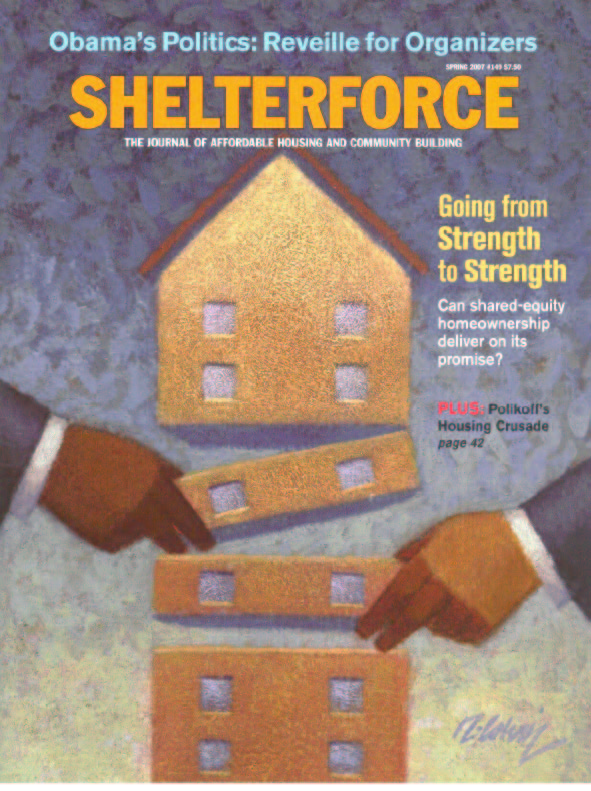
Permanent affordability and asset building might seem at first blush to be contradictory goals for a low-income homeownership program, but new research says in fact they can be achieved together. By Rick Jacobus
In the mid 1990s, the homeownership rate began to rise for the first time in decades. Social equity advocates were encouraged by the fact that, also for the first time, it appeared that ownership for lower income buyers and buyers of color was rising even faster. Policymakers in Washington cheered the fact that this change seemed to come from private mortgage market innovation rather than increased federal spending.
Looking back, this all seems like a dream—or rather a nightmare. Rather than opening a door to economic opportunity for disadvantaged families, “innovative” mortgage products led to financial ruin for families and for our whole economy.
The foreclosure crisis has led some policymakers to call for abandoning the goal of expanding access to homeownership. Certainly ownership has been oversold, and the current crisis demands a rethinking of housing policy including greater investment in affordable rental housing. But persistent and still-growing asset inequality (itself largely a product of discrimination in earlier generations of housing policy) remains a problem with very significant consequences, one that is unlikely to go away on its own. Any serious effort to overcome persistent asset inequality will require renewed efforts to overcome barriers to homeownership.
Luckily, relaxing credit standards is not the only strategy for expanding access to homeownership. Decades of experimentation in state and local programs have shown that it is possible to invest in homeownership in smarter and more sustainable ways. A new research report from the Urban Institute suggests that local programs that provide significant purchase assistance to low-income buyers while preserving long-term affordability can offer a sustainable and scalable strategy for overcoming generational asset inequality.
Homeownership and the Asset Gap
Social policy in the United States has long focused on income-based measures of poverty and inequality. Since the late 1980s, however, there has been a growing attention to asset poverty and asset inequality and over the past few decades assets have been distributed more unevenly than income, and asset disparities have grown wider. According to a 2003 Census Bureau report, the average African-American family has net assets of only $9,750 while the average white family has $79,400.
Most of this difference is home equity. The average homeowner has net assets of $235,000 while the average renter has only $5,000.
This persistent and growing asset inequality is both a result and an ongoing cause of widespread inequality in access to homeownership. During the period following WWII, when federal programs made homeownership possible for the great majority of American families, these same programs were actively promoting racial discrimination in the housing market. By the mid 1960s, when overcoming discrimination became a key federal housing goal, federal programs were, ironically, no longer contributing to rising homeownership rates. The homeownership gap between white and minority households has not changed in decades and is projected to be higher in 2010 than it was in 1910.
This historical ownership gap today drives continued inequality in access to homeownership—and by extension continued asset inequality. Renters who want to buy homes face multiple barriers including credit barriers, income barriers, and asset barriers. But recent studies have shown that asset barriers are the most widespread.
Many young families overcome a lack of savings through gifts or loans from their parents or other family members. One-third of white first-time homebuyers receive financial support from a family member, but only 6 percent of African-American buyers receive family assistance, and those who do receive much lower levels of assistance. Families that didn’t benefit from asset appreciation through homeownership in prior generations therefore find that they are unable help the next generation access homeownership today. The high cost of housing and lack of family assets have largely taken the place of overt discrimination in preventing minority families from buying homes today—but the result is just the same.
Overcoming the Wealth Barrier
And yet, we do know how to overcome these barriers and make ownership safe and affordable for lower income families.
A 2009 report by the U.S. Census Bureau estimated that 7 percent of current renters could safely afford to buy homes using standard mortgage products. They found that subsidizing mortgage rates by as much as 3 percentage points had virtually no effect on the number of renter families that could afford ownership and that offering loans with no downpayment requirements would increase that number by only 2 percentage points (to 9 percent). Providing purchase subsidies, on the other hand, had a more dramatic result. A subsidy of $10,000 (whether from a family member or a public program) would increase the number of renters who could qualify for ownership by 12 percentage points (to 19 percent).
In light of this research, it is surprising to note that while we spend billions of dollars annually on programs to expand homeownership, only a very small fraction is currently invested in purchase subsidy programs. This is so even though purchase subsidies are currently the dominant strategy for supporting affordable rental housing.
Programs that provide purchase assistance to bring the costs of homeownership down to an affordable level not only make ownership possible for lower-income buyers, they make it safer and more sustainable. Instead of borrowing more than they can afford to repay, qualified buyers borrow what their incomes can support, with the gap being covered not by a relative, but by a public or nonprofit agency.
Many believe, however, that these programs are simply too expensive to offer a realistic alternative to mortgage product innovation as a path to expanded homeownership.
A growing number of affordable homeownership programs address this concern by preserving long-term affordability so that a one-time public investment can make homeownership possible for one lower income family after another. These programs offer targeted assistance to buyers who would not be able to buy without such help and they preserve the affordability of assisted units so that many more households can ultimately benefit from the same initial investment. The growing stock of affordable homes in these programs offers a sustainable way to grow the overall rate of low-income and minority homeownership.
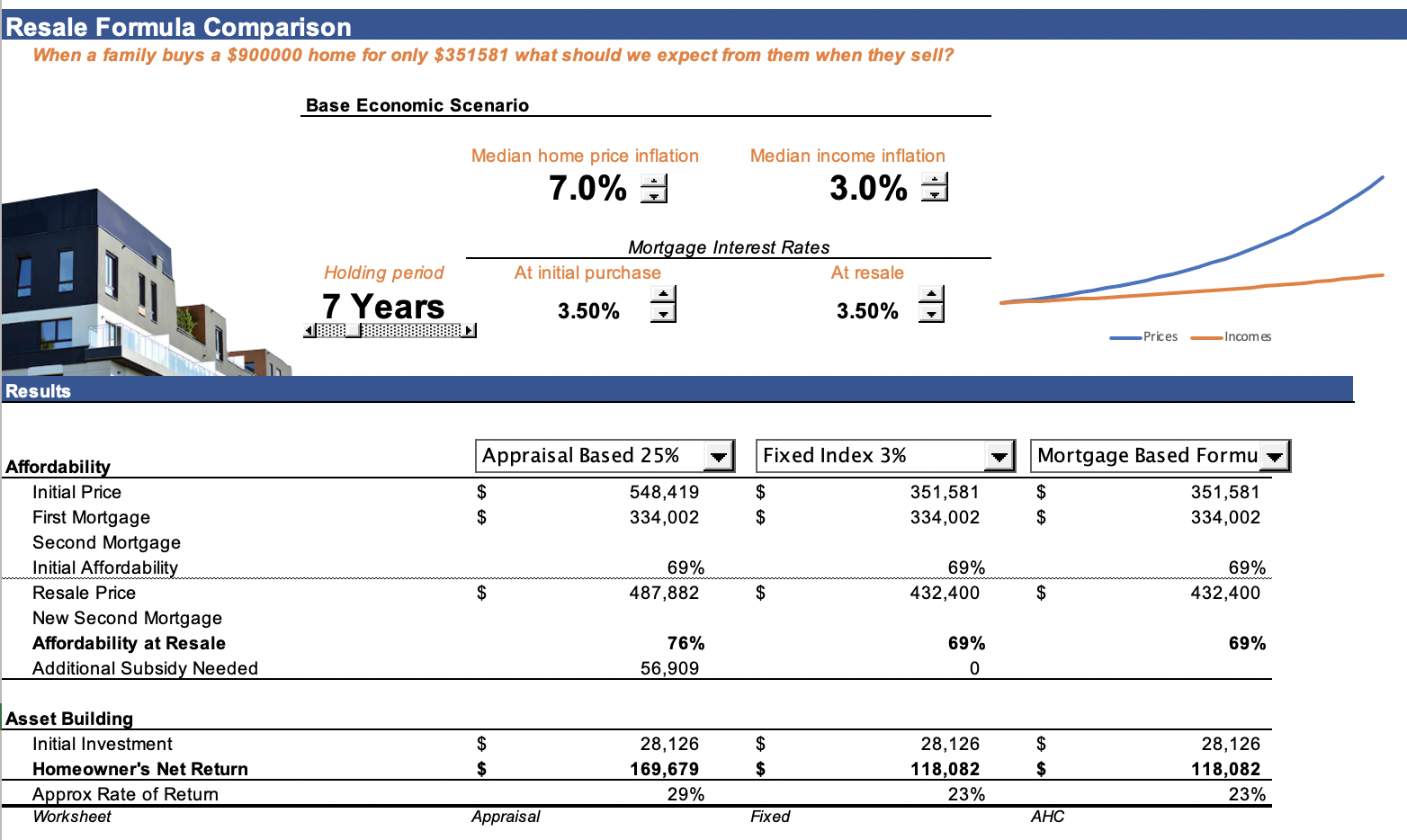
These programs achieve this result by limiting the level of price appreciation available to owners. In exchange for significant public support at the time of purchase, they require owners to pass that benefit along to future lower income buyers by reselling at an affordable price or repaying the subsidy along with a share of any market price appreciation. Participating homeowners do build assets, but in an expanding market they earn less than unrestricted market-rate homeowners.
Critics of this approach understandably question whether limiting a lower income buyer’s potential price appreciation defeats one of the key purposes of homeownership. If appreciation is limited, can affordable homeownership still offer a path out of generational asset poverty? If assisted homeowners can’t earn the same home equity gains that other owners enjoy, won’t they be trapped in affordable homes?
Policymakers face what sometimes seems like a no-win decision: either they make grants that offer wealth-building but only to a lucky few or they preserve affordability but sacrifice the goal of reducing asset inequality.
New Research
Though many working in programs that balance both goals have long said this was a false choice, for the first time, there is real data that shows that long term affordability and significant asset-building can go hand in hand.
NCB Capital Impact commissioned the Urban Institute to rigorously evaluate measurable outcomes for seven affordable homeownership programs that attempt to preserve long-term affordability. The Urban team analyzed data on home sales and subsequent resales through 2008 from three community land trusts, two limited-equity cooperatives, and two deed-restricted affordable housing programs.
Each of the programs in the Urban study imposes some form of price restriction designed to keep homes affordable. And yet, these programs nonetheless had strong asset-building outcomes at the same time.
Homeowners in these programs sold their homes after an average of three to six years. Their average total proceeds from sale ranged from $6,277 for a limited equity cooperative in Atlanta to $70,495 for owners in San Francisco’s Inclusionary Homeownership Program. In spite of the limitations, sellers received average appreciation ranging from $2,015 to $42,524.
Because, for the most part, homeowners made small initial investments, this appreciation tended to represent a very high annual return on investment. For example, in Boulder, Colo., the average Thistle CLT homebuyer invested $6,080 in downpayment and closing costs at purchase. The Boulder sellers moved after an average of 3.4 years and earned an average of $8,107 in appreciation. These buyers earned the equivalent of 22 percent annual interest on the money that they invested to buy their affordable homes (“internal rate of return”). In the programs in the Urban study, participants’ internal rates of return ranged from 6.5 percent to 59.6 percent. In all but one case, they built more equity than they would have if they had placed their downpayment in an S&P 500 index fund or a 10-year Treasury Bond.
But was it enough? The modest level of asset-building that these programs offer was enough to support sustained homeownership and to give households who originally couldn’t access the wider housing market the means to move on to buy a market-rate home.
As part of their research, the Urban Institute surveyed households that had sold affordable homes in one of the programs. In the four programs that participated in the questionnaire, a significant majority of sellers went on to buy owner-occupied
market-rate housing without any further public subsidy. Boulder had the highest rate, with 78 percent of sellers using their affordable unit as a stepping-stone to market-rate homeownership.
The annual turnover rate for the programs studied was comparable to national rates for all owners, dispatching concerns that participants would be locked into their properties.
Although assisted homeowners generally accumulated less home equity than buyers of unrestricted, market-rate homes, they also had significantly less risk. They were less likely to experience foreclosure than the average homebuyer—even though their average incomes are much lower (See Stewardship Works, SF #163). And they managed to sustain homeownership at a far higher rate. Several studies have found that roughly half of all low-income, first-time homebuyers revert to rental housing within five years. By contrast, fully 91 to 95 percent of homeowners in this study remained owners five years later, either continuing to occupy their affordable home or having acquired a market-rate home.
During a time when the housing market fluctuated drastically, the prices in all seven of these programs were remarkably stable, as were the income groups that could afford them. The result was that, because the homes remained affordable, the programs could offer safe and sustainable ownership and asset-building opportunities to a second, third, or fourth generation of buyers, generally without investing any further public subsidy. The Urban study found, for example, that the City of San Francisco was saving roughly $25 million annually by preserving affordability rather than having to introduce a new subsidy each time these homes were resold.
Affordable Ownership as an Asset-Building Strategy
Because these affordable homeownership programs can help families build wealth faster than investing in stocks or bonds with less risk than traditional homeownership, they offer a promising strategy for overcoming asset inequality. Much of the attention in asset-building policy has focused on individual development accounts (IDAs), which provide matched savings as an incentive to help lower income families build assets. While IDA programs generally serve a slightly lower income population, and they offer a way to save for important goals other than homeownership (including education and small businesses), they are often promoted as offering a path to homeownership for low-income participants. And yet most IDA participants are unable to save enough to access homeownership. Most IDA programs limit savings to $6,000 to $10,000 and the average IDA saver accumulates only $1,500. By comparison, affordable homeownership programs, even those with long-term affordability controls, seem of offer a more reliable way for low-income families to save enough to make traditional homeownership safely attainable.
Contrary to what many have thought, we do not have to choose between affordability and asset building. We can do both. By offering real equity to families who would otherwise remain renters, and providing a safer vehicle for them to attain—and retain—homeownership, affordable homeownership programs can provide a predictable avenue for asset building and economic advancement.