Portfolio Category: Shared Equity Homeownership

  • Social Impact Dashboard

    Social Impact Dashboard

    Screen Shot 2015-09-25 at 11.40.09 AM

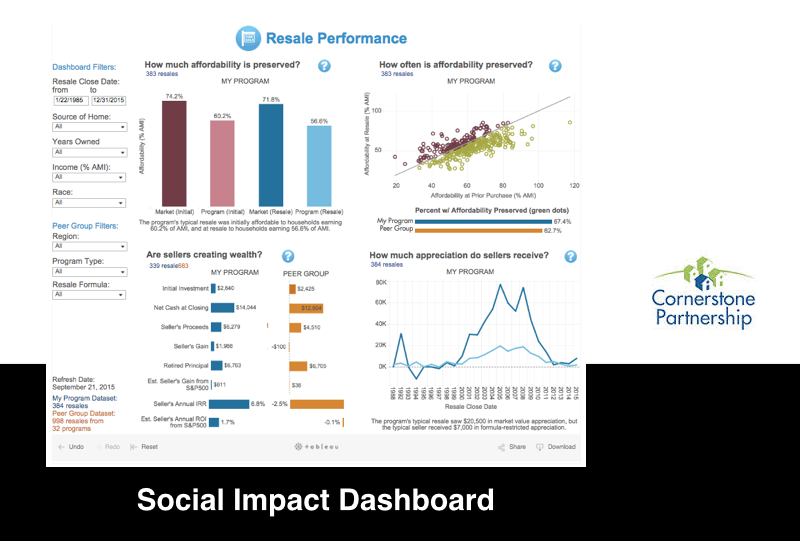
    Users of the HomeKeeper application enter data about their programs as a routine part of using the tool to get the job done. But HomeKeeper was designed to also provide a high level view into the social performance of the entire affordable homeownership sector. It does that by aggregating data from all of the HomeKeeper users into a single national data hub.

    The Social Impact Dashboard allows HomeKeeper users and others to engage with this data and better understand the performance of their organizations relative to their peer group.

    Play with the data yourself at MyHomeKeeper.org

  • The City-CLT partnership

    The City-CLT partnership

    Municipal Support for Community Land Trusts

    Published by the Lincoln Institute for Land Policy

    By John E. Davis and Rick Jacobus

    Download PDF File

    Based on interviews with dozens of practitioners from around the country, this guidebook is intended to help local government policymakers to develop stronger partnerships with local Community Land Trusts to develop and monitor permanently affordable homeownership units.

    Two companion documents were also produced:

    City-CLT Partnerships in Search of Best Practices

    City-CLT Regulatory Agreements

    Publisher’s Abstract:

    The community land trust (CLT) movement is young but expanding rapidly. Nearly 20 community land trusts are started every year as either new nonprofits or as programs or subsidiaries of existing organizations. Fueling this proliferation is a dramatic increase in local government investment and involvement. Over the past decade, a growing number of cities and counties have chosen not only to support existing CLTs, but also to start new ones, actively guiding urban development and sponsoring affordable housing initiatives.

    Two key policy needs are driving increased city and county interest in CLTs, particularly in jurisdictions that put a social priority on promoting homeownership for lower-income families and a fiscal priority on protecting the public’s investment in affordable housing.

    Long-term preservation of housing subsidies. With local governments now assuming greater responsibility for creating affordable housing, policy makers must find ways to ensure that their investments have a sustained impact. CLT ownership of the land, along with durable affordability controls over the resale of any housing built on that land, ensures that municipally subsidized homes remain available for lower-income homebuyers for generations to come.

    Long-term stewardship of housing. Preserving housing affordability requires long-term monitoring and enforcement, an administrative burden that local governments are neither equipped for nor generally interested in taking on. CLTs are well positioned to play this stewardship role by administering the municipality’s eligibility, affordability, and occupancy controls, while also “backstopping” lower-income owners to protect subsidized homes against loss through deferred maintenance or mortgage foreclosure.

    Municipal support comes in a variety of forms, depending on how well established the CLT is. For example, local governments may offer administrative or financial support during the planning and startup phase, followed by donations of city-owned land and grants or low-interest loans for developing and financing projects. They may help a CLT acquire and preserve housing provided by private developers to comply with inclusionary zoning, density bonuses, and other mandates or concessions. As the CLT builds its portfolio, municipalities may provide capacity grants to help support its operations. Finally, local jurisdictions may assist CLTs by revising their tax assessment practices to ensure fair treatment of resale-restricted homes built on their lands.

    As welcome as their support has been, local governments may inadvertently structure CLT funding and oversight in ways that undermine the effectiveness of the very model they are attempting to support. The challenge lies in finding the most constructive ways of putting municipal resources to work in pursuit of common objectives.

    Based on a review of three dozen municipal programs and in-depth interviews with local officials and CLT practitioners, this report describes the mechanisms and methods that cities across the country are using to structure their investment in CLT startups, projects, and operations. In addition to describing the full range of options for providing municipal support, the report highlights specific model practices for rendering that assistance. These practices have the most potential to balance the interests of all parties by: protecting the public’s investment in affordable housing; expanding and preserving access to homeownership for households excluded from the market; stabilizing neighborhoods buffeted by cycles of disinvestment or reinvestment; and ensuring accountability to funders, taxpayers, and the communities served by the CLT.

    The city-CLT relationship continues to evolve. This report ends with a discussion of three emerging trends: shifts in the city’s role from supporter to instigator, and from participant to governor; and a deepening of the CLT’s primary role as a steward of affordable housing created with municipal assistance. While posing new challenges, these changes also present new opportunities for tomorrow’s city-CLT partnerships
  • A Path to Homeownership

    A Path to Homeownership

    Building a More Sustainable Strategy for Expanding Homeownership

    A Path to Homeownership
    A Path to Homeownership

    Download PDF File

    Homeownership continues to provide real social and economic benefits and remains a high priority for most American families, but the United States is experiencing significant declines in the ownership rate for the first time in decades. What we need is greater availability of targeted purchase assistance programs that address wealth barriers to homeownership.

    Event Video:

    For more about this event, visit the Center for American Progress.

  • The Asset Building Potential of Shared Equity Homeownership

    The Asset Building Potential of Shared Equity Homeownership

    Download PDF

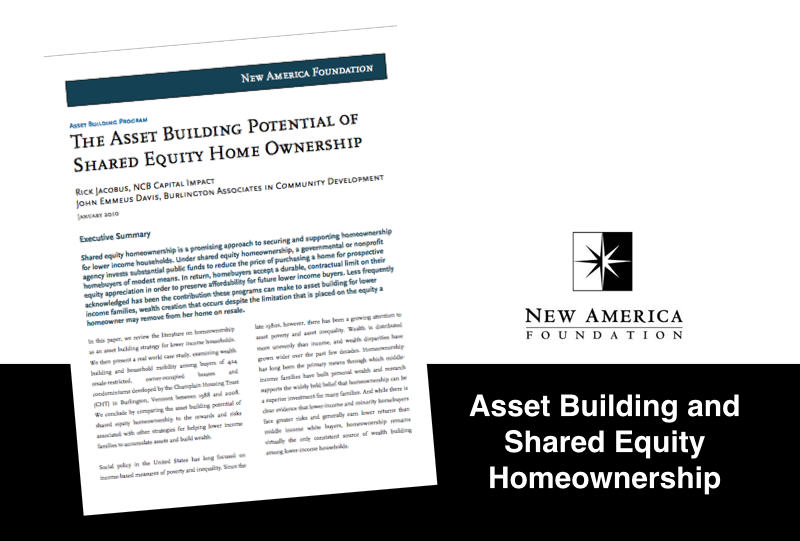
    In this paper for the New America Foundation, we review the literature on homeownership as an asset building strategy for lower income households. We then present a real world case study, examining wealth building and household mobility among buyers of 424 resale-restricted, owner-occupied houses and condominiums developed by the Champlain Housing Trust (CHT) in Burlington, Vermont between 1988 and 2008. We conclude by comparing the asset building potential of shared equity homeownership to the rewards and risks associated with other strategies for helping lower income families to accumulate assets and build wealth.

  • Asset Building and Affordable Homeownership

    Asset Building and Affordable Homeownership

    Homeownership has historically offered the best asset building strategy available to middle class American families. But homeownership has changed and is no longer available to many moderate income households. Local government programs that seek to make ownership affordable however frequently choose to limit the price that homeowners can sell for in order to preserve affordability for future buyers. But affordability protections are sometimes opposed by those who want to encourage homeowner wealth building. These debates are really about the very purpose of affordable homeownership programs. This 15 minute video presentation looks more closely at local affordable homeownership programs from the point of view of asset building. Can affordable ownership programs be seen as asset building strategies? How do they compare with traditional ownership?

    Learn more:

    Shared Equity Transformative Wealth
    Resale Formula Comparison Tool

  • Resale Formula Comparison Tool

    Resale Formula Comparison Tool

    Resale Formula Tool
    Resale Formula Tool

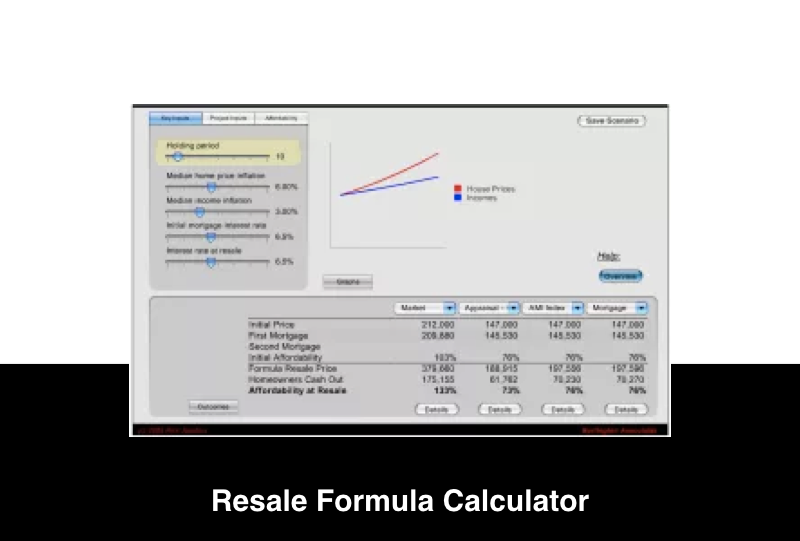
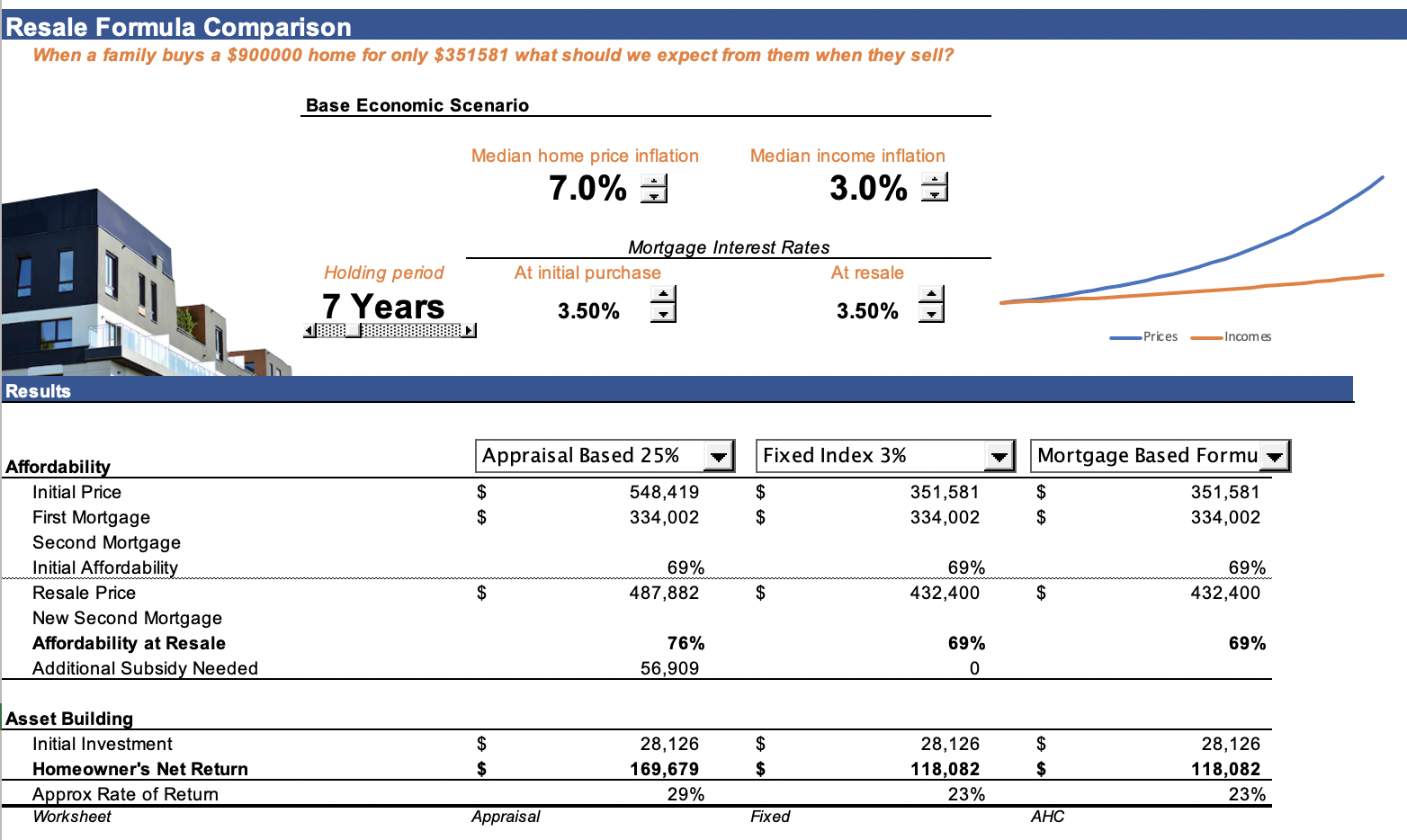
    This general purpose educational tool was designed to help community leaders understand the relative performance of different limited equity resale formulas. So much of what sets one model apart from the other is dependent on the assumptions you make about interest rates, home price inflation and income growth. This tool allows a side-by-side comparison between several models, and allows you to change these input assumptions and immediately see changes in the relative performance of each of the models in terms of both ongoing affordability and equity building for homeowners. The tool also allows you to look up historical data on home prices and median incomes for every metropolitan area in the country in order to get a better feel for what appropriate assumptions might be going forward.

    The tool compares several of the most common resale formulas including a basic AMI index, an appraisal based formula, a mortgage based formula and a shared equity loan model.

    The tool is intended to help policy makers to evaluate questions like:

    • When housing costs are rising rapidly, which approach preserves affordability best?
    • Which approach provides the greatest asset building opportunity in the face of rising interest rates?
    • If incomes grow more slowly than we expect, which approaches will be most impacted?

    You can make the analysis more relevant to your local conditions by customizing a number of background assumptions like cost of production for a new affordable unit, the level of subsidy available, and the monthly housing costs that homeowners will face.

    Excel resale formula comparison tool

    The web based version of the tool is no longer available.

    The latest version of the tool is an interactive Excel file. The file allows users to update key assumptions and then interactively compare multiple resale formulas. The tool includes 8 commonly used shared equity resale formulas and 5 custom models which can be modified to match existing or proposed local program designs. The excel version also allows the user to save up to 5 alternative economic scenarios to understand how the formulas perform under different potential futures (ie. rising interest rates, falling home prices, etc.) The tool is locked so that it is safe for inexperienced users to play with alternatives but designed to allow power users to make small or large modifications. The excel file is released under an open source license which allows for free sharing and modification.

    Download the excel file here.

  • Shared Equity/Transformative Wealth

    Shared Equity/Transformative Wealth

    Download Shared Equity, Transformative Wealth Written by Rick Jacobus.
    Published by the Center for Housing Policy of the National Housing Conference.

    This paper provides an analysis of several alternative strategies for sharing the equity growth that accompanies home price appreciation to balance the dual goals of individual asset accumulation and ongoing affordability to future home purchasers.

    As home prices have risen over the past decade, many local government homeownership programs have been forced to dramatically increase the level of public subsidy available to each family – some are now providing well over $100,000 per family. As subsidy levels have risen, more and more jurisdictions have turned to shared equity approaches that split the equity that results from home price appreciation. Under these approaches, a portion of the equity growth goes to the homeowner – augmenting the asset growth they achieve through paydown of principal on their mortgage – and a portion either stays attached to the home to ensure its ongoing affordability or goes back to the local government to be used to help subsequent purchasers afford to buy a home.

    Despite their great benefits, shared equity approaches are sometimes criticized from an asset-building perspective because they prevent homeowners from realizing the full wealth-creation benefits associated with traditional homeownership. In The Hidden Cost of Being African American, Thomas Shapiro uses the term “Transformative Assets” to refer to assets like homeownership that transform people’s lives and lead to better lives for their children. It is clear that traditional homeownership can have this kind of impact – at least in a stable or rising housing market – but what about shared equity homeownership? Given all the controversy over shared equity homeownership, it seems worth asking: how do shared equity homeownership programs perform as asset-building mechanisms? How do the returns available in these programs compare with market-rate ownership? Do some shared equity approaches do a better job of generating meaningful wealth while still preserving affordability? Is the equity that shared equity homeowners earn enough to change people’s lives?

  • Understanding Subsidy Retention

    Understanding Subsidy Retention

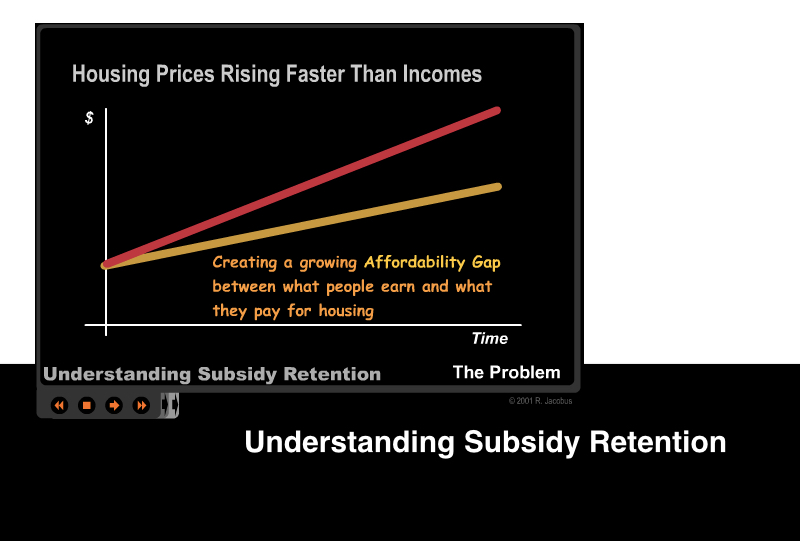
    We created this interactive tutorial on the economics of permanently affordable housing after trying to explain these concepts to small groups with static PowerPoint slides. The key to understanding the growing homeownership affordability challenge is the relative rates of change of housing prices and incomes. This idea is difficult to explain verbally but is relatively easy for people to understand with the help of simple drawings.

    The presentation has proven extremely popular and has been shown to thousands of people at a series of housing and urban development conferences. The latest version includes an imbedded voice narration. The presentation can also be run without the audio with either full text narration on screen or with bulleted text for live presentations to groups.

    View Interactive Animation at Burlington Associates


© Copyright 2012 – 2025 Street Level Advisors LLC  |  All Rights Reserved  |  Powered by WordPress

510.653.2995      Email Us