“Inclusionary Housing: Creating and Maintaining Equitable Communities,” charts a path forward for local policymakers who are grappling with the effects of gentrification, but who are wary of overburdening developers, impeding new housing construction, or inviting legal challenges. Through a review of literature and numerous case studies, author Rick Jacobus offers solutions for overcoming the major political, technical, legal and practical barriers to the adoption of inclusionary housing.
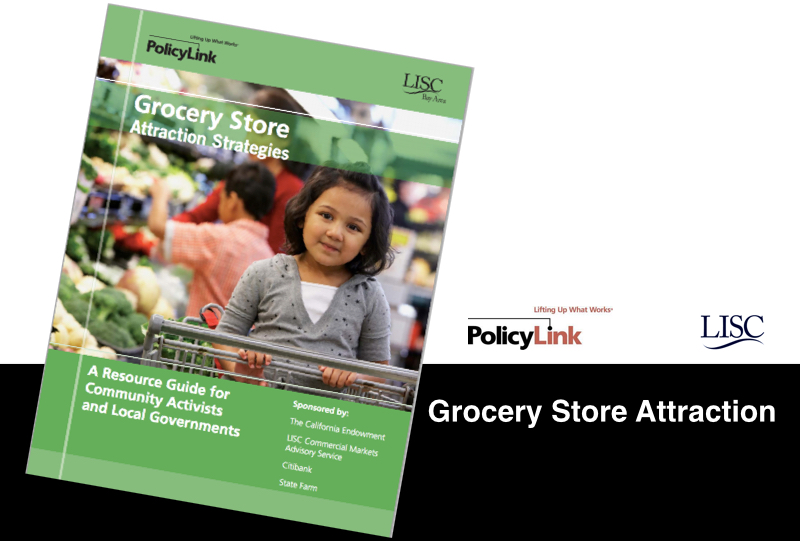
This report was commissioned by Bay Area LISC and PolicyLink with sponsorship from the California Endowment, LISC’s Commercial Markets Advisory Service, State Farm Insurance, and CitiBank. The report provides an overview of the process that community activists have used to attract new fresh food retailers into disinvested urban communities.
This toolkit developed for the Public Health Institute’s Land Use and Health Program is designed to provide an overview of Economic Development and Redevelopment issues for health advocates seeking new food stores in low income communities.
TABLE OF CONTENTS: Section I: Introduction to Economic Development, Redevelopment, and Health
1. Introduction to this Toolkit 2. The Connection Between Economic Development and Health 3. Why Do So Many Communities Lack Access to Healthy Food? 4. Developing a Strategy
Section II: Economic Development
5. What is Community Economic Development? 6. Types of Community Economic Development Programs 7. Economic Development Institutions 8. Financing Sources
Section III: Redevelopment
9. Overview of Redevelopment Law 10. Legal Requirements for Redevelopment 11. Introduction to Tax Increment Financing 12. Introduction to Eminent Domain 13. Support for Economic Development Projects 14. Final Points
Section IV: Strategies for Participation
15. Building Community Support 16. Data Collection 17. Model Redevelopment Resolution 18. Communicating with Public Officials
Section V: Appendices
Appendix 1: Sample Market Research Consultant Request for Proposals Appendix 2: Redevelopment Agency Model Resolution Appendix 3: Resources
This hands on guidebook is filled with detailed direction that will provide practitioners with a starting point for organizing comprehensive commercial district revitalization efforts. It takes the reader through each stage of revitalization from planning, research, and visioning to understanding the potential of the community, analyzing the business mix, marketing the assets, and implementing the work plan. The planning guide also provides a set of practical tools to assist in implementation.
Table of Contents: Forward Urban Commercial Revitalization Programs Planning For Revitalization Identifying and Involving Stakeholders Developing a Community-Based Vision Compiling Building and Business Inventories Understanding Market Data Using Surveys and Interviews to Collect Local Market Data Assessing Crime and Community Safety Developing Business Attraction Goals Evaluate Streetscape Conditions Branding the District Identity Defining an Implementation Strategy Measuring Impact