Portfolio Skill: Data Analysis

  • Public Life Evaluation

    Public Life Evaluation

    Street Level Advisors led a process for the John S. and James L. Knight foundation to evaluate a series of grants that the foundation has made to support the development of organizations focused on improving access to public space, and public life in American cities. The goal of this work was to connect and engage residents in their communities through more parks and public open spaces, bike and pedestrian lanes to enable people to connect, and programming that draws people together to share a common experience. This is an unusual focus for philanthropy and the Foundation wanted to know whether their investment was making a difference.

    Street Level interviewed nearly 50 neighborhood leaders and volunteers in communities where the funded work was conducted, listening to community stakeholders and capturing their sense of whether and how the work impacted the communities. In addition to documenting traditional measures of impact such as increases in the level of local spending and the number of permanent policy changes, we identified meaningful impacts related to community voice, identity, the development of local leadership and organizational capacity. We found that even temporary tactical urbanism type interventions (bike lanes, parklets, public events, etc.) could have a long-term impact. While the changes were not always lasting, we found that when the work was conducted in an inclusive and authentic way, local stakeholders reported lasting changes in community engagement. These creative public life projects seemed particularly likely to inspire new leaders and give them the confidence to undertake longer term efforts.

    Public Life Leadership Report cover

    Download the Report

  • Inclusionary Housing Calculator

    Inclusionary Housing Calculator

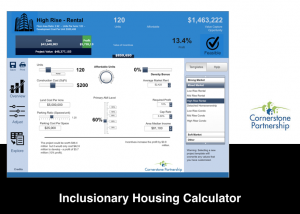
    This interactive tool published by Grounded Solutions Network was designed to help policymakers and advocates better understand the real estate economics related to inclusionary housing. The tool incorporates a complete real estate project pro forma but simplifies the inputs and outputs to allow users to focus on the key variables that drive project feasibility. Street Level Advisors led the development of the tool and defined the underlying financial model. We have developed custom regional models for the Twin Cities, Metro Vancouver and the Province of Ontario.

    Access the calculator at calc.InclusionaryHousing.org

  • Social Impact Dashboard

    Social Impact Dashboard

    Screen Shot 2015-09-25 at 11.40.09 AM

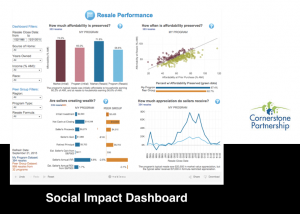
    Users of the HomeKeeper application enter data about their programs as a routine part of using the tool to get the job done. But HomeKeeper was designed to also provide a high level view into the social performance of the entire affordable homeownership sector. It does that by aggregating data from all of the HomeKeeper users into a single national data hub.

    The Social Impact Dashboard allows HomeKeeper users and others to engage with this data and better understand the performance of their organizations relative to their peer group.

    Play with the data yourself at MyHomeKeeper.org

  • HomeKeeper

    HomeKeeper

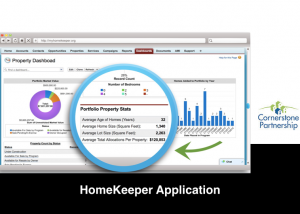
    HomeKeeper is a Salesforce.com application designed to help managers of affordable homeownership programs to track key program data and monitor the social impact of their programs.

    Learn more about it at MyHomeKeeper.org

  • Seattle Incentive Zoning Study

    Seattle Incentive Zoning Study

    Incentive Zoning Report

    By Rick Jacobus and Joshua Abrams

    The Seattle City Council commissioned this study to assess the impact of their Incentive Zoning policy. We compiled data about market rate housing production, affordable housing needs and the activity under Seattle’s Incentive Zoning Program in order to address a set of key questions relevant to potential changes to the IZ program.

    Download PDF File

  • Brookings: Retail Trade as a Path to Neighborhood Revitalization

    Brookings: Retail Trade as a Path to Neighborhood Revitalization

    Buy the book on Amazon.com

    Download the chapter: Retail Trade as a Path to Neighborhood Revitalization by Karen Chapple and Rick Jacobus

    A condensed version of the chapter was also produced by UC Berkeley’s Center for Community Innovation.

    From the introduction:
    “Retail trade is a highly visible feature in a community, and is often a symbol of economic status. Terms like “upscale retail,” “strip mall,” or “big box store,” convey very different images of retail trade that are widely associated with economic prosperity, or the lack thereof. But, does retail trade really revitalize run down or neglected neighborhoods? And if so, what are the mechanisms at work, the successful strategies, and necessary conditions that lead to success? In “Retail Trade as a Route to Neighborhood Revitalization,” Karen Chapple and Rick Jacobus tackle these questions. They begin by defining the issues and expectations associated with retail development and neighborhood revitalization. The authors state that, from the perspective of residents, there are three types of neighborhood revitalization: more access to services and opportunities for low-income populations; changes from a low-income neighborhood to a mixed income neighborhood (due either to an influx of newcomers or increases in incomes for local residents); and gentrification that gradually replaces existing low-income residents with more affluent newcomers. Using a conceptual model, Chapple and Jacobus describe the relationship between retail development and neighborhood revitalization.

    Their review of the literature finds mixed evidence for the assumption that low-income neighborhoods are underserved, and limited formal evaluation of the effects of retail development, especially with respect to overall neighborhood improvement. The authors acknowledge the challenges to evaluating retail development programs, such as their small scale, the variety of actors involved, and limited neighborhood level capacity. In reviewing the evidence, Chapple and Jacobus examine three broad strategies to retail revitalization: public-led retail development, private-led retail development, and commercial corridor revitalization. Retail strategies variously target job creation, vacancy rates, private investment, public investment, tax revenues and property values, crime and safety, and community identity. In order to further explore the relationship between these retail development goals and neighborhood revitalization, Chapple and Jacobus provide a case study of the San Francisco Bay Area, analyzing the relationship between retail and neighborhood revitalization from 1990 to 2005 in a region with unusual increases in income inequality accompanied by significant revitalization. They find that the way the retail sector changes is closely related to how the neighborhood changes, with increases in middle income residents (rather than gentrification or other forms of change) most closely associated with retail revitalization.

    The paper concludes with the suggestion that any large-scale impacts of retail development on community economic health occur indirectly, such as through changes in internal and external perceptions of the neighborhood and, ultimately, changes in neighborhood residential composition. But, the authors note that existing studies of the effectiveness of neighborhood retail development strategies have not explored these broader impacts. Chapple and Jacobus also recommend further research to address how outcomes for the poor are tied to the specific character of neighborhood change. Such research might suggest specific retail development strategies that are most likely to benefit the poor and lead to stable mixed-income communities without contributing to displacement of the poor.”

  • The Asset Building Potential of Shared Equity Homeownership

    The Asset Building Potential of Shared Equity Homeownership

    Download PDF

    In this paper for the New America Foundation, we review the literature on homeownership as an asset building strategy for lower income households. We then present a real world case study, examining wealth building and household mobility among buyers of 424 resale-restricted, owner-occupied houses and condominiums developed by the Champlain Housing Trust (CHT) in Burlington, Vermont between 1988 and 2008. We conclude by comparing the asset building potential of shared equity homeownership to the rewards and risks associated with other strategies for helping lower income families to accumulate assets and build wealth.

  • Resale Formula Comparison Tool

    Resale Formula Comparison Tool

    Resale Formula Tool
    Resale Formula Tool

    This general purpose educational tool was designed to help community leaders understand the relative performance of different limited equity resale formulas. So much of what sets one model apart from the other is dependent on the assumptions you make about interest rates, home price inflation and income growth. This tool allows a side-by-side comparison between several models, and allows you to change these input assumptions and immediately see changes in the relative performance of each of the models in terms of both ongoing affordability and equity building for homeowners. The tool also allows you to look up historical data on home prices and median incomes for every metropolitan area in the country in order to get a better feel for what appropriate assumptions might be going forward.

    The tool compares several of the most common resale formulas including a basic AMI index, an appraisal based formula, a mortgage based formula and a shared equity loan model.

    The tool is intended to help policy makers to evaluate questions like:

    • When housing costs are rising rapidly, which approach preserves affordability best?
    • Which approach provides the greatest asset building opportunity in the face of rising interest rates?
    • If incomes grow more slowly than we expect, which approaches will be most impacted?

    You can make the analysis more relevant to your local conditions by customizing a number of background assumptions like cost of production for a new affordable unit, the level of subsidy available, and the monthly housing costs that homeowners will face.

    Excel resale formula comparison tool

    The web based version of the tool is no longer available.

    The latest version of the tool is an interactive Excel file. The file allows users to update key assumptions and then interactively compare multiple resale formulas. The tool includes 8 commonly used shared equity resale formulas and 5 custom models which can be modified to match existing or proposed local program designs. The excel version also allows the user to save up to 5 alternative economic scenarios to understand how the formulas perform under different potential futures (ie. rising interest rates, falling home prices, etc.) The tool is locked so that it is safe for inexperienced users to play with alternatives but designed to allow power users to make small or large modifications. The excel file is released under an open source license which allows for free sharing and modification.

    Download the excel file here.

  • Shared Equity/Transformative Wealth

    Shared Equity/Transformative Wealth

    Download Shared Equity, Transformative Wealth Written by Rick Jacobus.
    Published by the Center for Housing Policy of the National Housing Conference.

    This paper provides an analysis of several alternative strategies for sharing the equity growth that accompanies home price appreciation to balance the dual goals of individual asset accumulation and ongoing affordability to future home purchasers.

    As home prices have risen over the past decade, many local government homeownership programs have been forced to dramatically increase the level of public subsidy available to each family – some are now providing well over $100,000 per family. As subsidy levels have risen, more and more jurisdictions have turned to shared equity approaches that split the equity that results from home price appreciation. Under these approaches, a portion of the equity growth goes to the homeowner – augmenting the asset growth they achieve through paydown of principal on their mortgage – and a portion either stays attached to the home to ensure its ongoing affordability or goes back to the local government to be used to help subsequent purchasers afford to buy a home.

    Despite their great benefits, shared equity approaches are sometimes criticized from an asset-building perspective because they prevent homeowners from realizing the full wealth-creation benefits associated with traditional homeownership. In The Hidden Cost of Being African American, Thomas Shapiro uses the term “Transformative Assets” to refer to assets like homeownership that transform people’s lives and lead to better lives for their children. It is clear that traditional homeownership can have this kind of impact – at least in a stable or rising housing market – but what about shared equity homeownership? Given all the controversy over shared equity homeownership, it seems worth asking: how do shared equity homeownership programs perform as asset-building mechanisms? How do the returns available in these programs compare with market-rate ownership? Do some shared equity approaches do a better job of generating meaningful wealth while still preserving affordability? Is the equity that shared equity homeowners earn enough to change people’s lives?

  • Inclusinary Housing in California

    Inclusinary Housing in California

    Inclusionary Housing Report

    Written By Rick Jacobus and Maureen Hickey.

    Download PDF File

    Affordable By Choice:Trends in California Inclusionary Housing Programs was commissioned by the Nonprofit Housing Association of Northern California, The California Coalition for Rural Housing, The San Diego Housing Federation and the Sacramento Housing Alliance. The report details the findings of a statewide survey of local government agencies that have adopted inclusionary housing policies. Key findings include:

    * Nearly one-third of California jurisdictions have inclusionary programs
    * More then 80,000 Californians have housing through inclusionary programs
    * Most inclusionary housing in integrated within market rate developments
    * Inclusionary housing provides shelter for those most in need
    * Lower-income households are best served through partnerships


© Copyright 2012 – 2025 Street Level Advisors LLC  |  All Rights Reserved  |  Powered by WordPress

510.653.2995      Email Us