Category: Community Land Trusts

  • Comparing Shared Equity Resale Formulas

    [fusion_builder_container hundred_percent=”no” hundred_percent_height=”no” hundred_percent_height_scroll=”no” hundred_percent_height_center_content=”yes” equal_height_columns=”no” menu_anchor=”” hide_on_mobile=”small-visibility,medium-visibility,large-visibility” status=”published” publish_date=”” class=”” id=”” background_color=”” background_image=”” background_position=”center center” background_repeat=”no-repeat” fade=”no” background_parallax=”none” enable_mobile=”no” parallax_speed=”0.3″ video_mp4=”” video_webm=”” video_ogv=”” video_url=”” video_aspect_ratio=”16:9″ video_loop=”yes” video_mute=”yes” video_preview_image=”” border_size=”” border_color=”” border_style=”solid” margin_top=”” margin_bottom=”” padding_top=”” padding_right=”” padding_bottom=”” padding_left=””][fusion_builder_row][fusion_builder_column type=”2_3″ layout=”2_3″ spacing=”” center_content=”no” link=”” target=”_self” min_height=”” hide_on_mobile=”small-visibility,medium-visibility,large-visibility” class=”” id=”” background_color=”” background_image=”” background_image_id=”” background_position=”left top” background_repeat=”no-repeat” hover_type=”none” border_size=”0″ border_color=”” border_style=”solid” border_position=”all” border_radius=”” box_shadow=”no” dimension_box_shadow=”” box_shadow_blur=”0″ box_shadow_spread=”0″ box_shadow_color=”” box_shadow_style=”” padding_top=”” padding_right=”” padding_bottom=”” padding_left=”” margin_top=”” margin_bottom=”” animation_type=”” animation_direction=”left” animation_speed=”0.3″ animation_offset=”” last=”no”][fusion_text columns=”” column_min_width=”” column_spacing=”” rule_style=”default” rule_size=”” rule_color=”” hide_on_mobile=”small-visibility,medium-visibility,large-visibility” class=”” id=””]
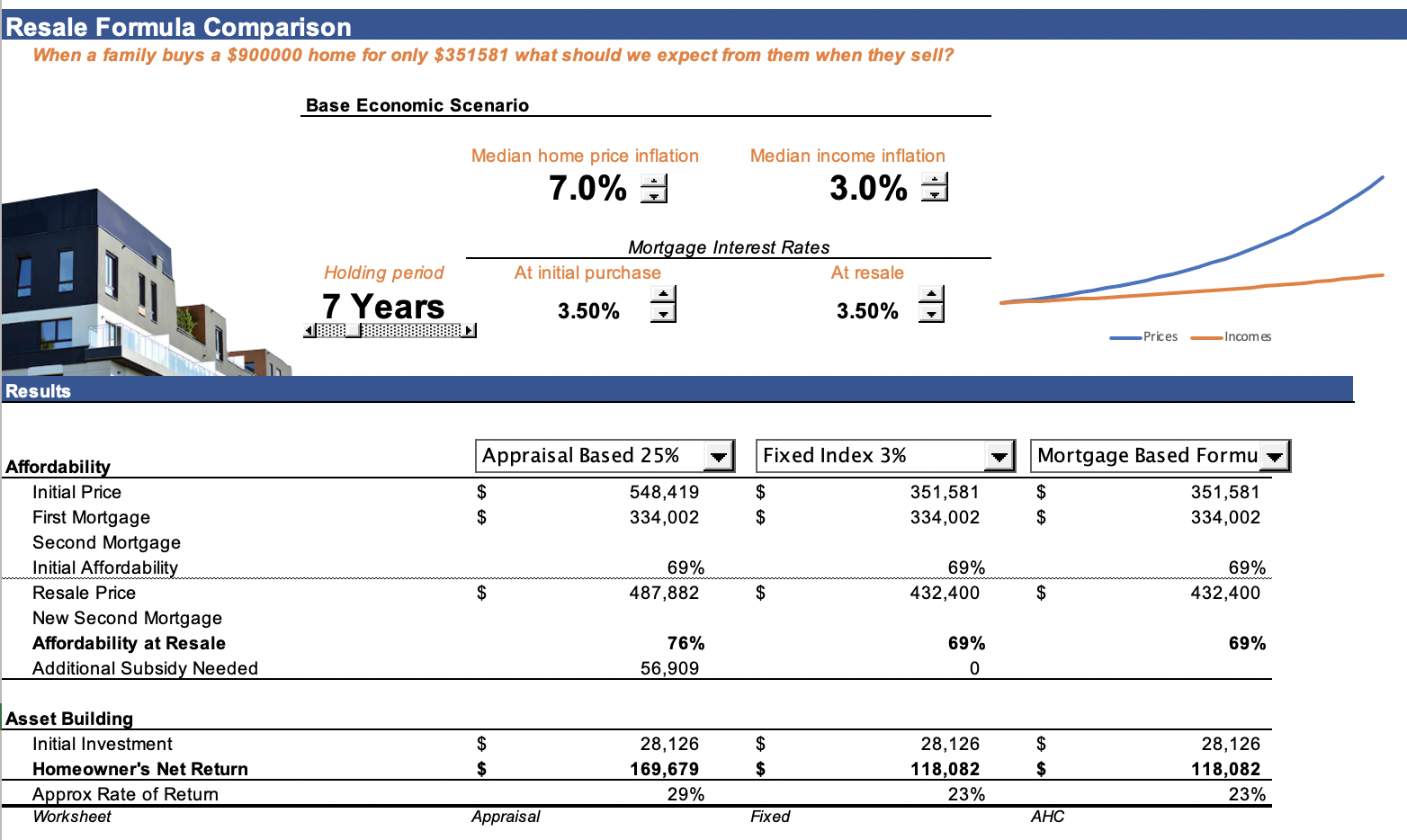
    This general purpose educational tool was designed to help community leaders understand the relative performance of different shared equity resale formulas. So much of what sets one model apart from the other is dependent on the assumptions you make about interest rates, home price inflation and income growth. This tool allows a side-by-side comparison between several models, and allows you to change these input assumptions and immediately see changes in the relative performance of each of the models in terms of both ongoing affordability and equity building for homeowners.

    The tool is intended to help policy makers and community members to evaluate questions like:
    · When housing costs are rising rapidly, which approach preserves affordability best?
    · Which approach provides the greatest asset building opportunity in the face of rising interest rates?
    · If incomes grow more slowly than we expect, which approaches will be most impacted?

    You can make the analysis more relevant to your local conditions by customizing a number of background assumptions like cost of building a new affordable unit, the level of subsidy available, and the monthly housing costs that homeowners will face.

    The latest version of the tool is an interactive Excel file.  The tool includes 8 commonly used shared equity resale formulas and 5 custom models which can be modified to match existing or proposed local program designs. The excel version also allows the user to save up to 5 alternative economic scenarios to understand how the formulas perform under different potential futures (ie. rising interest rates, falling home prices, etc.)  The tool is locked so that it is safe for inexperienced users to play with alternatives but not password protected to allow power users to make small or large modifications. The excel file is released under an open source license which allows for free sharing and modification.

    Download the excel file here.

    [/fusion_text][/fusion_builder_column][fusion_builder_column type=”1_3″ layout=”1_3″ spacing=”” center_content=”no” link=”” target=”_self” min_height=”” hide_on_mobile=”small-visibility,medium-visibility,large-visibility” class=”” id=”” background_color=”” background_image=”” background_image_id=”” background_position=”left top” background_repeat=”no-repeat” hover_type=”none” border_size=”0″ border_color=”” border_style=”solid” border_position=”all” border_radius=”” box_shadow=”no” dimension_box_shadow=”” box_shadow_blur=”0″ box_shadow_spread=”0″ box_shadow_color=”” box_shadow_style=”” padding_top=”” padding_right=”” padding_bottom=”” padding_left=”” margin_top=”” margin_bottom=”” animation_type=”” animation_direction=”left” animation_speed=”0.3″ animation_offset=”” last=”no”][fusion_text columns=”” column_min_width=”” column_spacing=”” rule_style=”default” rule_size=”” rule_color=”” hide_on_mobile=”small-visibility,medium-visibility,large-visibility” class=”” id=””]

    The Resale Comparison Calculator allows side by side comparison of the most common types of shared equity resale formulas, showing how well they preserve affordability for future buyers as well as their performance in building wealth for homeowners.

    [/fusion_text][/fusion_builder_column][/fusion_builder_row][/fusion_builder_container]

  • Shelterforce: Cities and CLTs

    Shelterforce: Cities and CLTs

    Download City Hall Steps In Written by Rick Jacobus and Michael Brown. Published By Shelterforce.

    This article from Shelterforce Magazine outlines the growing trend of municipal sponsorship of Community Land Trusts including profiles of new CLTs in Irvine, CA and Chicago.

    Shelterforce.jpg

  • Hemet considers new ways to boost housing

    Tuesday, September 1, 2009

    By MICHAEL PERRAULT
    The Press-Enterprise

    Hemet officials may have a new tool next month to create affordable housing: a community land trust.

    Community land trusts are nonprofit, community-based housing organizations that acquire land through purchases or donations and hold it in perpetuity, said Rick Jacobus, an Oakland-based consultant hired to look into forming the land.

    The land is then leased to the homeowners for as long as 99 years, cutting the overall cost of homes and helping to promote affordable housing.

    The trust could also work with lenders to reduce mortgage costs by using equity of the land as part of the mortgage calculation.

    “By retaining ownership of the land, the city is sort of a silent partner,” Jacobus said.

    Hemet could screen potential homebuyers and tenants while ensuring homes are adequately maintained and occupied by working families instead of being bought up by investors, Jacobus said.

    Another option Hemet City Council may consider is joining forces with a non-profit affordable housing developer, said Adam Eliason, president of CivicStone, a Chino-based consulting firm that advises cities on how to develop affordable housing.

    Eliason and Jacobus have been asked to work the city’s housing authority to develop a business plan to boost affordable housing options, stabilize blighted neighborhoods and reduce absentee ownership.

    Hemet officials want to buy and fix up foreclosed properties and sell them to working families. The city plans to use nearly $3 million awarded by the U.S. Housing and Urban Development Department’s Neighborhood Stabilization Program, said Mark Trabing, Hemet housing manager.

    Hemet has teamed up with Moreno Valley to apply for a second round of federal funding, Trabing said.

    The city council teamed up in July with two nonprofit housing groups to improve their chances of receiving about $10 million in additional federal Neighborhood Stabilization grants.

    Hemet is awaiting word whether it will receive about $3 million more to be used to purchase and renovate homes for resale, rent or redevelopment and to demolish blighted structures.

    Hemet’s land trust would likely be governed by a board of directors representing people who lease the land, as well as surrounding neighbors, public officials, nonprofit housing providers and social services.

    Land trusts have sprouted up in cities such as Madison, Wis., where teachers, police and other workers with modest, middle-class incomes were priced out of neighborhoods.

    A land trust could give Hemet a chance to be involved on an ongoing basis, helping neighborhoods break out of “boom and bust cycles” that have left residents facing foreclosures.

  • Shelterforce: Cities and CLTs

    Shelterforce: Cities and CLTs

    Download City Hall Steps In Written by Rick Jacobus and Michael Brown. Published By Shelterforce.

    This article from Shelterforce Magazine outlines the growing trend of municipal sponsorship of Community Land Trusts including profiles of new CLTs in Irvine, CA and Chicago.

    Shelterforce.jpg

  • Preservation of Affordable Homeownership

    Preservation of Affordable Homeownership

    Download Preservation of Affordable Homeownership: A Continuum of Strategies Written by Rick Jacobus and Jeff Lubel.
    Published by the Center for Housing Policy of the National Housing Conference.

    chp_se_transwealth_0407_sm.png

    In recognition of the significant benefits of homeownership for families and the communities in which they live, many cities, counties and states have adopted policies that seek to increase residents’ access to affordable homeownership opportunities. This paper examines the range of different policy options that communities have adopted to reduce the cost of homeownership, with a particular focus on the effectiveness of each option in preserving affordable homeownership opportunities over time.

    The focus of this review on the preservation of affordable homeownership grows out of the collective experience of numerous communities around the country with sharply rising home prices over the past five to ten years. As many communities have learned the hard way, homes that they helped make affordable through an initial downpayment grant or other assistance often have become unaffordable when sold to the next family. With the amount of subsidy needed to bring homeownership within reach of working families growing exponentially, communities have struggled with the question of how to ensure that the public’s investments in homeownership keep pace with the market. This review provides an overview of the range of mechanisms that local governments use to ensure that housing funds invested in affordable homeownership today are able to serve additional families into the future. In general, this is accomplished either through resale restrictions that preserve the affordability of specific assisted units or through deferred loans that allow the locality to capture a portion of home price appreciation at the time that assisted units are sold that can then be used to help subsequent buyers purchase homes of their choice.

  • Creating Permanently Affordable Homeownership with CLTs

    Creating Permanently Affordable Homeownership with CLTs

    [fusion_builder_container hundred_percent=”yes” overflow=”visible”][fusion_builder_row][fusion_builder_column type=”1_1″ background_position=”left top” background_color=”” border_size=”” border_color=”” border_style=”solid” spacing=”yes” background_image=”” background_repeat=”no-repeat” padding=”” margin_top=”0px” margin_bottom=”0px” class=”” id=”” animation_type=”” animation_speed=”0.3″ animation_direction=”left” hide_on_mobile=”no” center_content=”no” min_height=”none”]

    Subsidy Retention
    Subsidy Retention

    By Rick Jacobus and Amy Cohen

    in California Affordable Housing Deskbook, Solano Press.

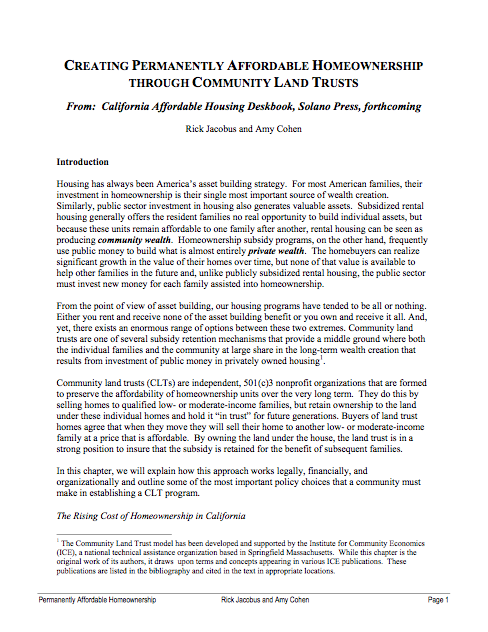
    Written for local elected officials and housing program administrators, this chapter explains how Community Land Trusts operate and places them within a continuum of other policy alternatives.

    Download the PDF file[/fusion_builder_column][/fusion_builder_row][/fusion_builder_container]


© Copyright 2012 – 2025 Street Level Advisors LLC  |  All Rights Reserved  |  Powered by WordPress

510.653.2995      Email Us